Tailings Dam Monitoring: How Advanced Satellite Intelligence Is Transforming Tailings Dam Safety
Tailings dams are among the most critical—and high-risk—structures in the global mining industry. Built to store the by-products of mineral processing, these facilities must remain stable not for years, but for decades, sometimes centuries. When a tailings dam fails, the consequences extend far beyond a mine boundary: communities are devastated, ecosystems collapse, and economic damage spreads across entire regions.
Yet despite increasing regulatory standards and the Global Industry Standard on Tailings Management (GISTM), tailings dam failures continue to occur worldwide. The challenge is not simply engineering—it is persistent monitoring.
Today, tailings dam monitoring is evolving from periodic ground inspections to continuous, satellite-based geospatial intelligence. XRTech Group provides a comprehensive ecosystem for tailings dam monitoring that replaces slow, manual inspection cycles with persistent, millimeter-level orbital oversight powered by advanced SAR, InSAR, hyperspectral imaging, and AI-driven analytics.
This article explores:
What tailings dams are and why they fail
Why traditional monitoring methods are no longer enough
How satellite InSAR delivers millimeter-level deformation detection
How hyperspectral imaging strengthens environmental compliance
Why integrated AI-based early warning systems are critical
How XRTech’s orbital ecosystem provides 24/7, all-weather monitoring
Understanding Tailings Dams: A High-Risk Engineering Reality
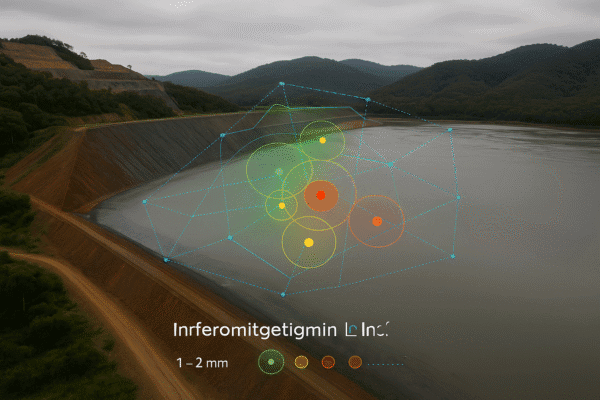
Tailings are the fine-grained waste materials left after extracting valuable minerals from ore. Often stored as a slurry composed of water, crushed rock, chemical residues, and fine sediments, tailings must be contained within engineered storage facilities known as Tailings Storage Facilities (TSFs).
Tailings dams are typically constructed using one of three methods:
Upstream
Downstream
Centreline
Each design responds to site-specific environmental, seismic, and hydrological conditions. However, regardless of design, tailings dams share a fundamental characteristic: they often store unstable, saturated material behind embankments that may themselves be constructed from tailings.
Unlike conventional water-retention dams, tailings dams are raised incrementally as production increases. This sequential raising process introduces structural complexity, drainage challenges, and long-term stability risks.
When failures occur, they are often catastrophic.
Historical records show more than 200 documented failures in the past century. Unlike conventional dams, tailings dam failure rates are significantly higher. The reasons are complex and interrelated.
Why Tailings Dams Fail
Tailings dam failures rarely occur without warning. They are typically the result of progressive structural degradation combined with insufficient monitoring.
Key causes include:
Static Liquefaction
Loose, saturated tailings can suddenly lose shear strength, causing rapid structural collapse.
Seepage and Pore Pressure
Water slowly permeating through embankments can erode foundation material. Increased pore pressure reduces slope stability and may trigger failure.
Overtopping
Excess rainfall or water mismanagement can cause tailings levels to exceed crest elevation.
Seismic Activity
Even moderate earthquakes can destabilize improperly consolidated tailings.
Sequential Raising Without Adequate Consolidation
Upstream dams especially require careful timing between raises to ensure consolidation. Inattention increases risk.
Long-Term Neglect
Inactive dams often receive less monitoring, despite the fact that tailings must remain stable for thousands of years.
The core issue is that most traditional monitoring systems detect problems after visible movement occurs. By the time cracks or slope deformation are seen on-site, instability may already be advanced.
Modern tailings dam monitoring must detect changes before they become visible.
The Evolution of Tailings Dam Monitoring
Historically, monitoring relied on:
Piezometers to measure pore pressure
Inclinometers to track internal deformation
Total earth pressure cells
Seismic sensors
Ground-based radar systems
These technologies remain valuable, but they have limitations:
Limited spatial coverage
Expensive installation and maintenance
Vulnerability to environmental damage
Dependence on physical access
Human data collection delays
As tailings dams grow larger and more complex, operators require continuous, wide-area, high-precision monitoring. This is where satellite-based InSAR changes the paradigm.
Structural Integrity Monitoring via InSAR
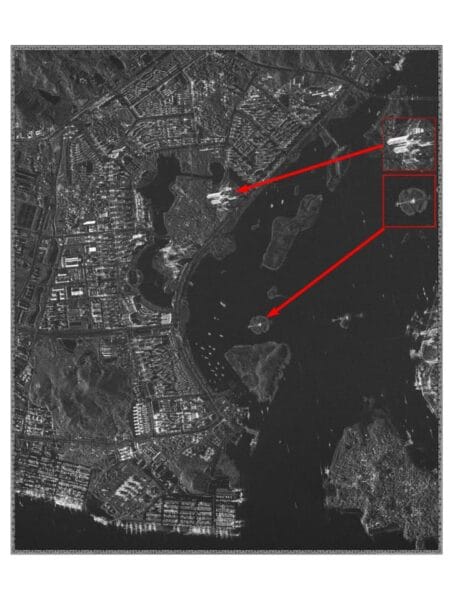
The cornerstone of XRTech Group’s tailings dam monitoring ecosystem is Interferometric Synthetic Aperture Radar (InSAR).
InSAR compares radar signals collected from multiple satellite passes over the same location. By analyzing phase differences, it detects surface displacement at extremely fine scales.
Millimeter-Level Precision
XRTech’s InSAR systems detect movement as small as 1–2 millimeters across dam walls, slopes, and surrounding terrain.
This level of precision allows operators to identify:
Progressive subsidence
Slope instability
Foundation settlement
Early-stage embankment deformation
These subtle signals often precede catastrophic failure.
Unlike visual inspections, InSAR identifies movement trends over time, not just isolated snapshots.
Dedicated Deformation Monitoring Satellites
XRTech leverages the LT-1 L-band SAR constellation, specifically designed for surface deformation interferometry.
L-band radar provides improved penetration into soil and vegetation compared to shorter wavelengths, enhancing measurement reliability over tailings surfaces.
Because satellites revisit regularly, deformation histories can be constructed, allowing engineers to evaluate acceleration patterns and intervene early.
All-Weather, 24/7 Monitoring: The SAR Advantage
One of the most critical weaknesses of optical satellite systems is their dependence on clear weather and daylight.
Tailings dams are often located in:
High rainfall regions
Tropical zones
Areas with persistent cloud cover
Remote regions with limited access
XRTech’s SAR fleet acts as an unblinking eye.
Cloud and Smoke Penetration
SAR sensors operate in microwave frequencies that penetrate clouds, fog, and smoke.
Day and Night Capability
SAR is an active sensor—it provides its own illumination. Monitoring continues regardless of darkness.
This means tailings dam monitoring does not pause during monsoon seasons or extreme weather events—the very conditions that increase failure risk.
Persistent oversight dramatically reduces blind spots in risk management.
Environmental Impact and Contamination Monitoring
Structural stability is only one part of tailings dam safety. Environmental contamination risk must also be managed continuously.
Tailings reservoirs can release contaminants through:
Seepage into groundwater
Surface overflow
Leakage into surrounding soil
XRTech integrates hyperspectral satellite imaging to monitor environmental conditions around tailings facilities.
Water Quality Analysis
Hyperspectral data enables detection of:
Turbidity changes
Suspended solids
Heavy metal signatures
pH-related spectral shifts
Surface contamination spread
Unlike ground sampling, which is periodic and localized, hyperspectral imaging surveys the entire reservoir and surrounding ecosystem.
Pollution Prevention
By identifying anomalous spectral signatures downstream from tailings facilities, operators can detect potential leakage before contamination spreads widely.
Historical Change Analysis
XRTech maintains archives dating back to 1999. By comparing current satellite data with historical imagery, mining companies can:
Assess long-term land degradation
Evaluate remediation effectiveness
Support closure planning
Strengthen ESG reporting
This time-depth intelligence transforms environmental monitoring from reactive compliance to strategic oversight.
Integrated AI for Early Warning and Disaster Prevention
Data alone does not prevent failure. Interpretation speed matters.
XRTech integrates satellite monitoring with AI-powered analytics platforms that automatically identify:
Deformation acceleration
Moisture anomalies
Stress indicators
Terrain instability trends
These systems generate automated alerts when predefined risk thresholds are exceeded.
Instead of waiting for periodic engineering reviews, operators receive continuous digital risk intelligence.
Emergency Response Capability
In the event of an incident or sudden geohazard, XRTech can deliver emergency satellite imaging and actionable analysis within as fast as 24 hours.
This rapid response capability supports:
Crisis containment
Evacuation planning
Environmental impact assessment
Regulatory reporting
Speed matters when downstream communities are at risk.
Meeting Global Tailings Standards
The Global Industry Standard on Tailings Management emphasizes:
Continuous monitoring
Transparency
Risk reduction
Zero harm objectives
To achieve zero harm, monitoring systems must integrate surface and sub-surface intelligence.
XRTech’s ecosystem supports:
Remote satellite InSAR
Hyperspectral environmental analysis
Historical archive comparison
AI-based anomaly detection
This integrated approach aligns with evolving regulatory frameworks while reducing manual inspection dependency.
Why Satellite-Based Tailings Dam Monitoring Is Now Essential
Tailings dams are not temporary structures. Many must remain stable for thousands of years.
Climate change introduces new stressors:
Increased rainfall intensity
Extreme flooding
Accelerated erosion
Seismic unpredictability
Manual inspections and isolated sensors cannot provide full-site awareness at required scale.
Satellite-based InSAR provides:
Wide-area coverage
Millimeter-level accuracy
Continuous revisit
No on-site installation requirement
Historical deformation trend analysis
When combined with hyperspectral environmental monitoring, operators gain both structural and ecological intelligence.
The XRTech Advantage in Tailings Dam Monitoring
XRTech Group offers a comprehensive monitoring ecosystem rather than a single instrument.
This includes:
LT-1 L-band SAR for deformation monitoring
Multi-satellite constellation for global coverage
Hyperspectral imaging for contamination detection
Historical archive access since 1999
AI-driven anomaly detection systems
24/7 all-weather capability
Emergency imaging within 24 hours
Unlike systems that rely solely on ground-based radar or isolated sensors, XRTech provides orbital oversight that continuously scans large tailings facilities and surrounding terrain.
This transforms monitoring from episodic to persistent.
From reactive to predictive.
From manual to intelligent.
Are There Any Alternatives to Tailings Dams?
Tailings dams have long been the dominant method for storing mine waste, but they are not the only option. As environmental expectations rise and regulatory scrutiny increases, mining companies are actively exploring safer, lower-risk alternatives to conventional wet tailings storage facilities (TSFs). While no solution is universally applicable, several technologies and design approaches are reducing dependence on large slurry-filled embankments.
Understanding these alternatives is essential for both risk reduction and long-term sustainability.
Dry Stacking (Filtered Tailings)
One of the most widely discussed alternatives is dry stacking, also known as filtered tailings.
In this approach, water is removed from tailings using filtration systems before disposal. The resulting material resembles damp soil rather than slurry. It is then compacted and stacked in layers, eliminating the need for large water-retaining embankments.
Because there is significantly less water involved, the risk of catastrophic liquefaction or overtopping is reduced. Dry stacking also allows better water recovery, which is valuable in water-scarce regions.
However, dry stacking comes with trade-offs:
Higher upfront capital cost
Increased energy consumption for filtration
Not always feasible for very large-scale operations
Requires specific climatic and geotechnical conditions
While safer in many contexts, dry stacking does not eliminate the need for monitoring. Stability, drainage, and erosion must still be managed continuously.
Thickened or Paste Tailings
Thickened tailings represent a middle ground between conventional slurry dams and fully dry stacking. In this method, tailings are dewatered to a higher density before being deposited.
Paste tailings flow slowly and consolidate faster, reducing free water accumulation and lowering the risk of static liquefaction. This approach can reduce dam height requirements and improve geotechnical stability.
However, thickened tailings facilities still require containment structures and ongoing monitoring. They are not inherently failure-proof.
In-Pit Tailings Disposal
Some mining operations use exhausted open pits as containment areas for tailings. By placing waste material within existing mine voids, operators reduce the need for new embankments.
In-pit storage can reduce environmental footprint and structural exposure, but it is only feasible where geological and hydrogeological conditions allow. Groundwater contamination risk must still be carefully managed.
Underground Backfilling
In underground mining, tailings can sometimes be mixed with binders and used as backfill material to stabilize mined-out cavities.
This reduces surface storage requirements and improves underground structural integrity. However, it is limited to specific mining methods and does not eliminate surface disposal entirely.
Water Cover and Subaqueous Disposal
In some regions, tailings are deposited under a water cover to reduce oxidation and acid generation. While this method can minimize certain environmental reactions, it still requires careful dam design and long-term water management.
Do Alternatives Eliminate Risk?
No alternative completely removes risk.
Every tailings management strategy—whether conventional dam, dry stack, or in-pit storage—requires continuous structural and environmental monitoring. Climate variability, seismic activity, and long-term geotechnical behavior introduce uncertainties that cannot be engineered away entirely.
The real shift in modern tailings management is not just about alternative storage methods. It is about integrating continuous monitoring technologies that provide early warning of instability.
Tailing Dam Monitoring Remains Essential — Regardless of Design
Even alternative tailings systems must be monitored for:
Ground deformation
Seepage patterns
Surface instability
Environmental contamination
Long-term consolidation behavior
Satellite-based InSAR, SAR, and hyperspectral imaging play a critical role in overseeing both conventional and alternative facilities.
For example:
Dry stack facilities can still experience slope movement.
In-pit storage requires groundwater monitoring.
Thickened tailings may still undergo consolidation settlement.
Persistent orbital monitoring ensures early detection of movement trends before they escalate into structural hazards.
The Future of Tailings Management
The industry is gradually shifting toward lower-risk designs, improved filtration technologies, and stricter global standards such as the Global Industry Standard on Tailings Management.
However, structural design alone cannot guarantee safety over decades or centuries.
True resilience comes from combining:
Improved engineering design
Regulatory oversight
Continuous satellite monitoring
AI-driven anomaly detection
Historical data analysis
Tailings dam alternatives reduce risk, but monitoring eliminates blind spots.
Blog Summary
Tailings Dam Monitoring is critical because tailings dams store mining waste slurry that can cause catastrophic environmental and human damage if structural failure occurs.
A Tailings Dam can fail due to seepage, static liquefaction, overtopping, seismic activity, poor drainage, or long-term neglect—most failures are preceded by measurable warning signs.
Traditional monitoring methods such as piezometers and ground inspections are limited in coverage, while satellite-based InSAR monitoring provides wide-area, continuous deformation tracking.
XRTech Group uses Interferometric Synthetic Aperture Radar (InSAR) to detect surface displacement as small as 1–2 mm, enabling early warning before visible cracks or collapse occur.
The LT-1 L-band SAR constellation delivers millimeter-level deformation monitoring with all-weather and day-night capability, ensuring uninterrupted tailings dam surveillance.
Unlike optical systems, SAR-based tailings dam monitoring penetrates clouds, rain, fog, and smoke, making it reliable in monsoon and high-risk climate conditions.
XRTech integrates hyperspectral satellite imaging to monitor environmental risks, including water contamination, heavy metal presence, turbidity changes, and ecosystem degradation around tailings reservoirs.
Historical satellite archives dating back to 1999 allow mining operators to analyze long-term deformation trends, land subsidence, and environmental impact patterns.
AI-driven early warning systems automatically flag terrain stress indicators and deformation acceleration, strengthening proactive risk mitigation and compliance with global tailings standards.
Effective Tailings Dam Monitoring requires a multi-sensor ecosystem combining InSAR, SAR, hyperspectral imaging, and AI analytics to prevent failures, protect communities, and ensure regulatory compliance.