
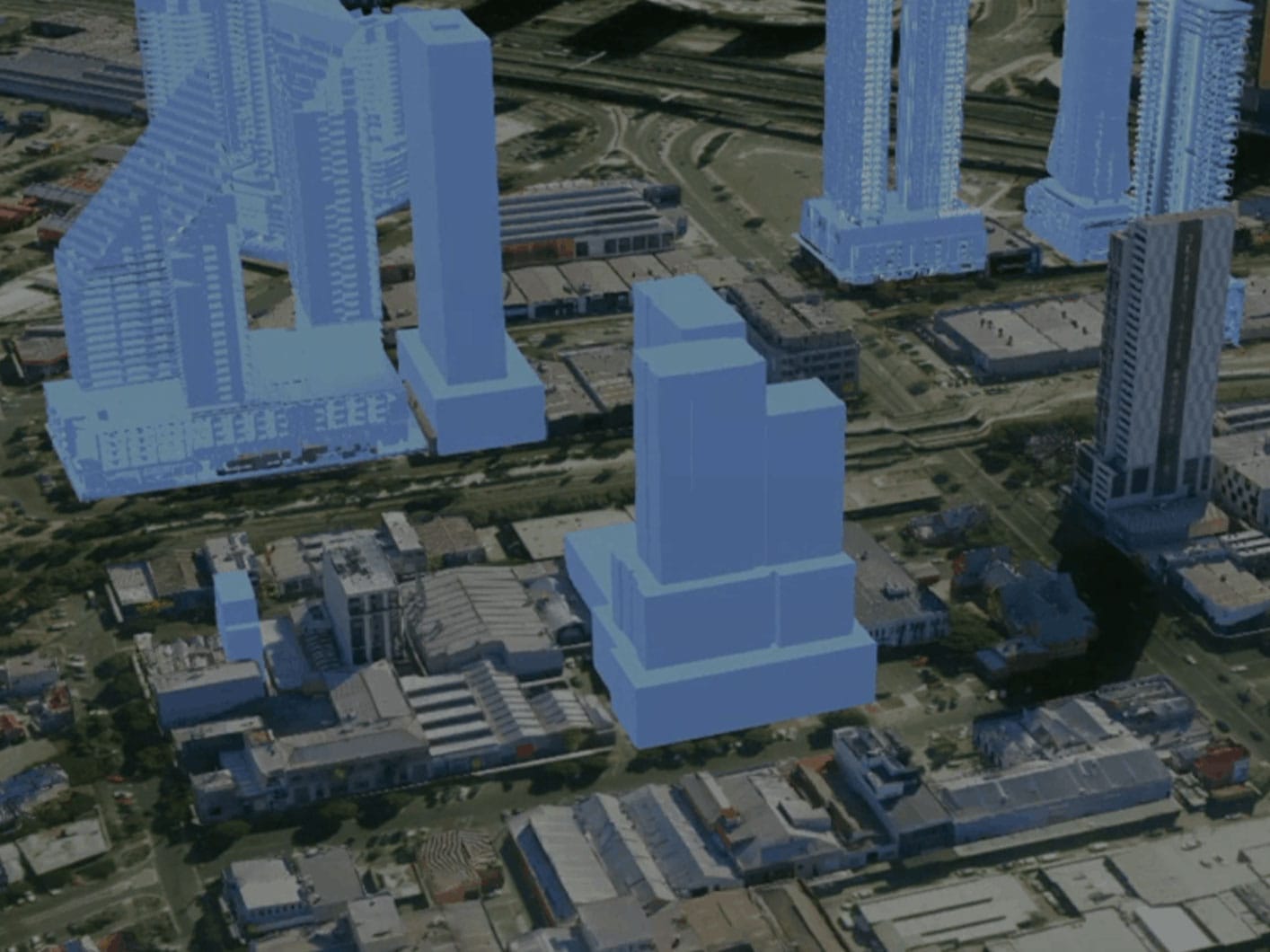
3D City Models and Digital Twins from Satellite Imagery
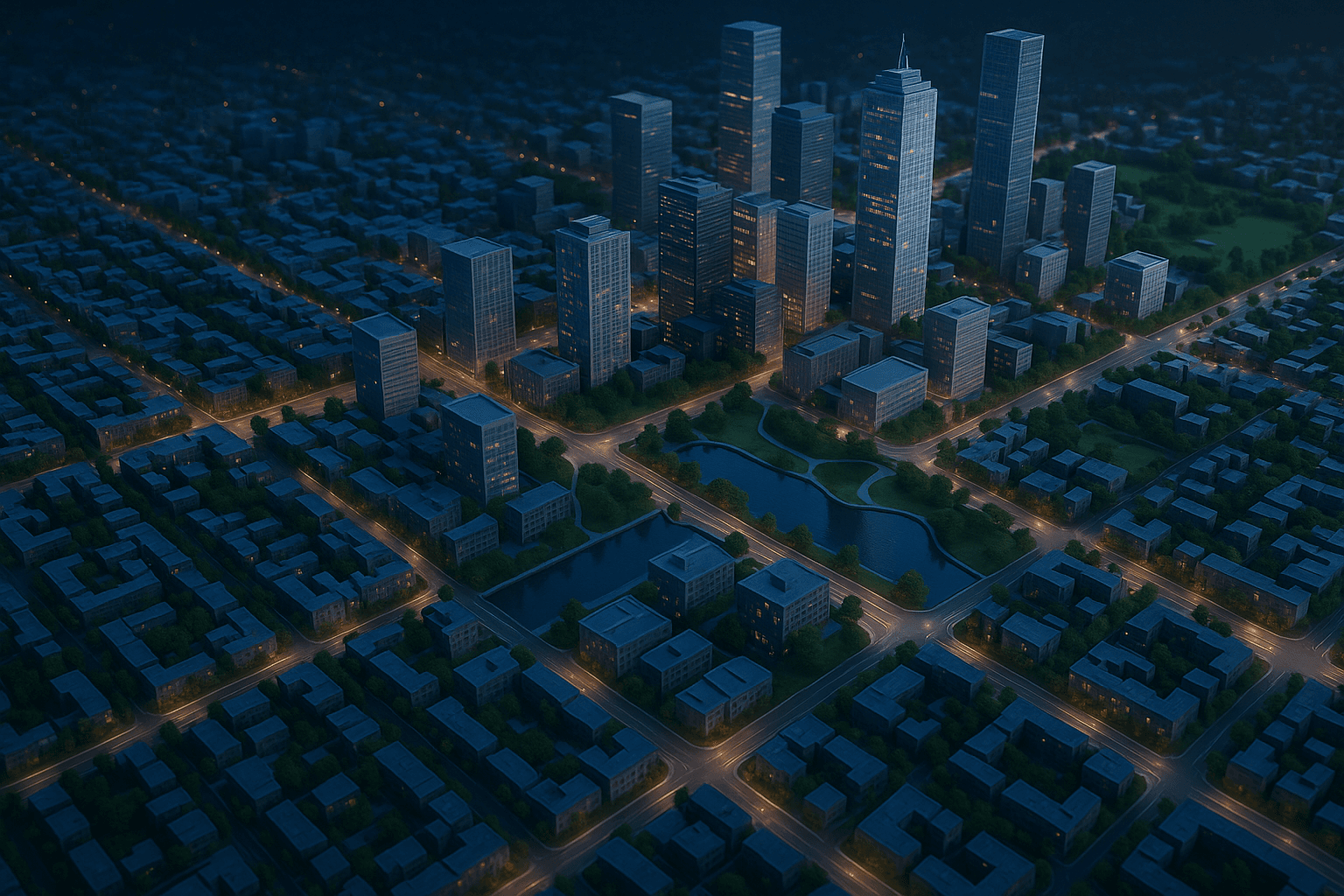
We build 3D city models for any city on Earth, with every building, road and property mapped. Our city modelling turns stereo satellite imagery into geometrically accurate 3D data, building white models, textured 3D models and digital twins for smart city planning, engineering and simulation, ready for your workflows.
130+
Satellites in our constellation
50 TB
Imagery processed daily on our cloud platform
60 PB
Of geospatial data in storage
6-step
AI pipeline for building white models
What Is a 3D City Model?
A 3D city model is a georeferenced digital model of an urban area that represents buildings, terrain, roads, vegetation and infrastructure in three dimensions, with real coordinates and real heights. It is built at a chosen level of detail, from simple building blocks to textured models, and is used for design, planning, simulation and analysis.
Request a 3D Model Consultation →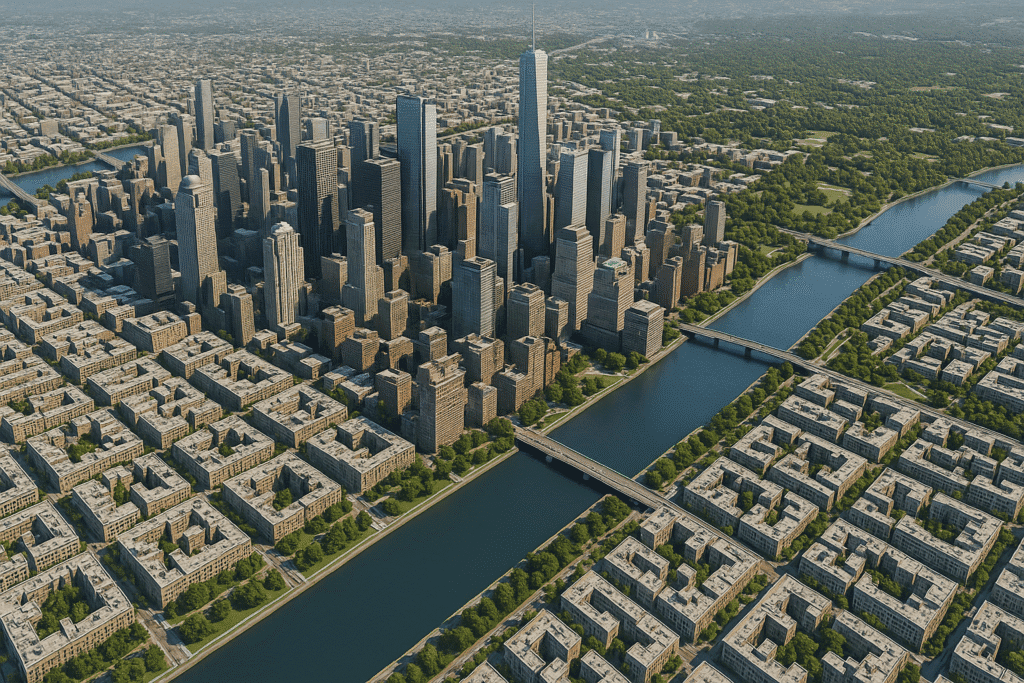
The Building White Model (LOD1)
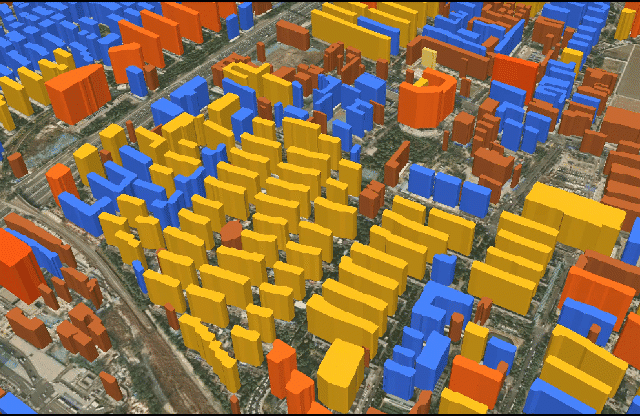
A building white model is a simplified 3D box model of each real building, without facade textures. Light enough to load an entire city at once, it is the base layer for large-scale city displays, urban planning, smart park platforms and disaster assessment.
Characteristics: Features the standard building contour, accurate height measurement, real coordinate position, and 3D shape.
From 3D City Model to Digital Twin
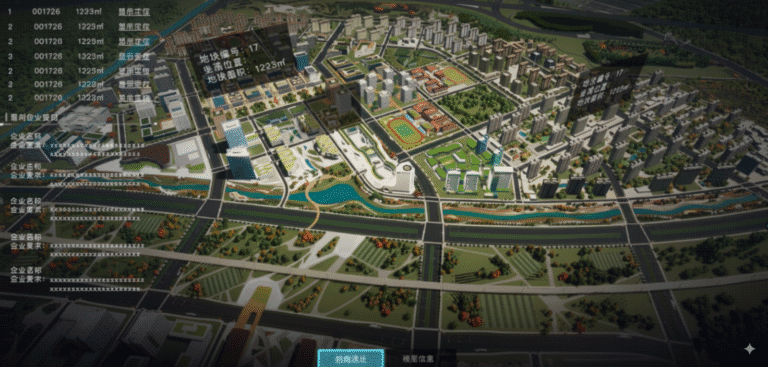
A 3D city model is the geometry. A digital twin connects it to IoT sensors, traffic, energy or InSAR ground-movement data, turning a static model into a working tool for planning, construction, operation and investment.
Observability: live sensor and video feeds appear in place on a holographic 3D scene of the city.
Simulation: run what-if scenarios, such as a new tower, a flood or a road closure, on the virtual city before acting on the real one.
3D City Model Levels of Detail (LOD)
Levels of detail (LOD) are defined by the OGC CityGML standard and describe how much of each building a city model shows. Choose the lowest LOD that answers your question: every step up adds cost and production time.
Level
What the model shows
Typical data source
Best for
LOD0
Building footprints draped on terrain (2.5D)
Orthophoto and DEM
Base maps, cadastre, flood extent mapping
LOD1 (white model)
Flat-roofed building blocks with real heights
Stereo satellite DSM plus extracted footprints
City-wide planning, density and massing studies
LOD2
Real roof shapes: flat, gable, hip and mixed
30 to 50 cm tri-stereo satellite or aerial imagery
Roof-level studies such as solar potential, plus realistic visualisation
Textured model
LOD1 or LOD2 geometry wrapped in orthophoto textures
Satellite orthophotos (DOM) on the 3D geometry
Stakeholder presentations and public consultation
LOD3 and LOD4
Facades, windows and balconies (LOD3), interiors (LOD4)
Aerial oblique, drone, terrestrial scanning or BIM
Architecture, heritage and building-level design
LOD3 and LOD4 need aerial, drone or ground capture, so they sit outside satellite-only projects.
3D City Model Specifications
Specification
XRTech 3D city models
Source imagery
0.3 to 0.65 m stereo and tri-stereo satellite imagery
Model types
LOD0 footprints, LOD1 white models and textured models as standard; LOD2 roof models and digital twin scenes on request
Elevation base
DSM and DEM at 2 to 10 m grid spacing, plus true-colour orthophotos (DOM) for textures
Orthophoto (DOM)
Pixel-aligned 50 cm orthophoto textures with 8 m CE90 positional accuracy, plus GeoTIFF and IMG raster delivery
Vertical accuracy
About ±3 m RMSE as standard; about 1 m with GF-7 imagery and ground control points
Horizontal accuracy
Sub-meter to 8 m CE90, depending on sensor and ground control
3D model formats
.gltf, .fbx, .obj, .3ds, .dae, .x, .ifc, .rvt, .dgn
3D Tiles and oblique mesh
.3dtiles (Cesium 3D Tiles), .i3s, .s3m, .osgb, .obj
Point clouds
.las, .laz, .xyz, .txt
GIS vector data
.shp, .gdb, .geojson, .kml, .sqlite, .dwg/.dxf
Coordinate systems
WGS84, UTM or your local coordinate system
Delivery time
Archive stereo imagery in 4 to 7 days, custom elevation data in under 21 days; full model timeline confirmed in your quote
How We Build a 3D City Model from Satellite Imagery
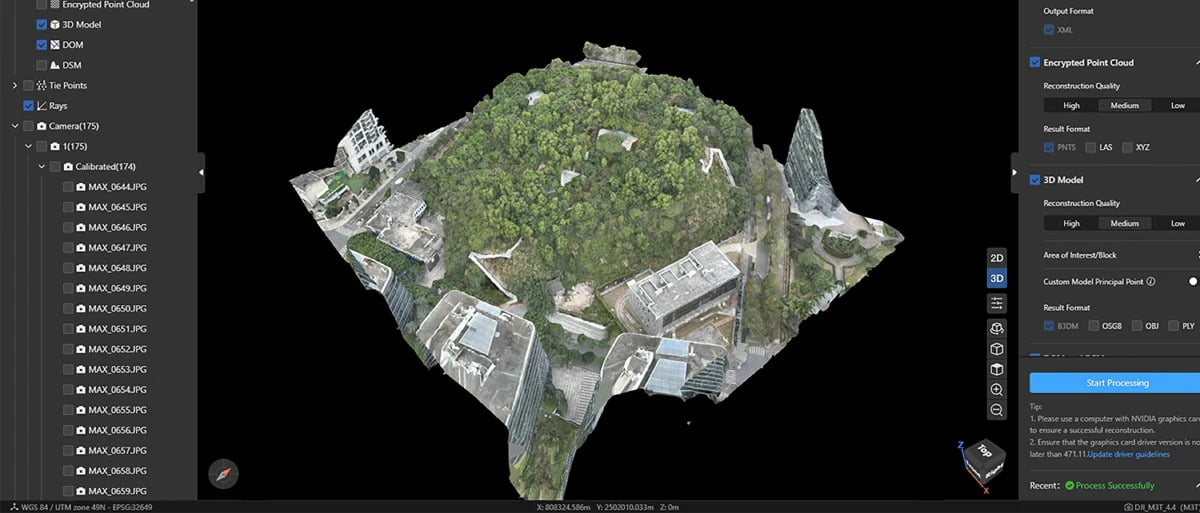
Building white models are made in an automated, batch-production cloud pipeline built on our DEMs and DSMs and textured with Digital Orthophoto Maps (DOMs), turning stereo imagery into geometrically accurate 3D data.
01
Stereo Pair Acquisition
We collect high-resolution left and right optical stereo pairs from agile satellites such as GF-7, SuperView-1, SuperView-2 and Beijing-3A, from archive or new tasking.
02
AI Contour Extraction
Deep learning models identify and extract raw building contours directly from the imagery across whole 3D cities and metro areas, while roads and property boundaries are captured in the orthophoto layer.
03
Building Regularization
Principal direction strategies remove sharp angles, simplify redundant points and fit each outline to its real geometric shape, giving clean, geometrically accurate building footprints.
04
Adhesion Segmentation
Attached buildings are split apart. Height-based segmentation uses elevation data to separate neighbours with large height differences, and co-edge segmentation splits structures of similar height along their shared wall.
05
Homonymous Contour Pairing
Pairing algorithms match each building outline across the left and right viewing angles of the stereo pair, checking that both views agree before the building goes into the model.
06
Elevation Correction and Height Calculation
The maximum overlap of the left and right building polygons fixes the true roof elevation, and building height is calculated against the base terrain DEM. Orthophoto textures are then applied where a textured model is ordered.
Map the Whole City, Not Just the Skyline
Many 3D products stop at the central business district. Satellite stereo covers a city edge to edge, so your model includes the suburbs, industrial zones, ports and growth corridors where most planning decisions actually happen.
Because every block comes from the same imagery and the same processing, the whole city model shares one capture date and one accuracy level, with no seams between downtown and the outskirts.
From one district to a full metro area
Order a single neighbourhood for a feasibility study or an entire metropolitan area for a city-wide digital twin. The area follows your project, not a fixed product footprint.
New suburbs and informal settlements
Fast-growing districts are often missing or out of date in aerial city products. Recent satellite imagery captures them as they stand today.
Track change over time
Compare city models built from imagery of different dates to see exactly what was built, extended or demolished in between.
Regional context around the city
Extend the model past city limits with DEMs and orthophotos of the surrounding terrain, airports and transport corridors.
Satellite vs Aerial vs LiDAR City Modelling
Pre-built models from aerial 3D Cities products usually cover a fixed list of large metro areas. If your city is not on that list, needs frequent updates, or sits under restricted airspace, satellite city modelling is often the practical route. Many projects combine methods: satellite for the whole city, aerial or LiDAR for the centre.
Factor
Satellite stereo
Aerial photogrammetry
Airborne LiDAR
Coverage
Any city worldwide, including restricted airspace
Cities where survey flights are permitted and flown
Project corridors and selected areas
Typical detail
LOD1 to LOD2 from 30 to 50 cm imagery
LOD2 to LOD3 from 5 to 15 cm imagery
Dense point clouds with very accurate heights
Permits
None needed
Flight permits and airspace clearance
Flight permits and airspace clearance
Updates
Revisit in days, archive going back years
New flight campaign for each update
New flight campaign for each update
Cost per km²
Lowest, especially for large areas
Medium to high
Highest
Best for
City-wide and national models, emerging markets, change tracking
Photorealistic city centres
Engineering-grade terrain, utilities and vegetation
Analysis Tools Inside Your 3D City Model
Once delivered, the 3D environment becomes a working analysis space, with tools for calculation, simulation and customized 3D visualizations tailored to your business questions.
Flooding Analysis
Light Analysis
Volume Measurement
Area Measurement
Demolition Analysis
Path Planning
Perspective Analysis
Greenfield Analysis
Roaming Customization
3D City Model Applications
3D models have become a staple for multiple industries, including government, telecom, AEC, utilities, transportation, insurance, real estate and entertainment. City engineers create digital twins for smart city planning, telecom network designers map clean lines of sight, insurers assess exposure building by building, and studios build realistic city scenes. These are the three most requested uses.
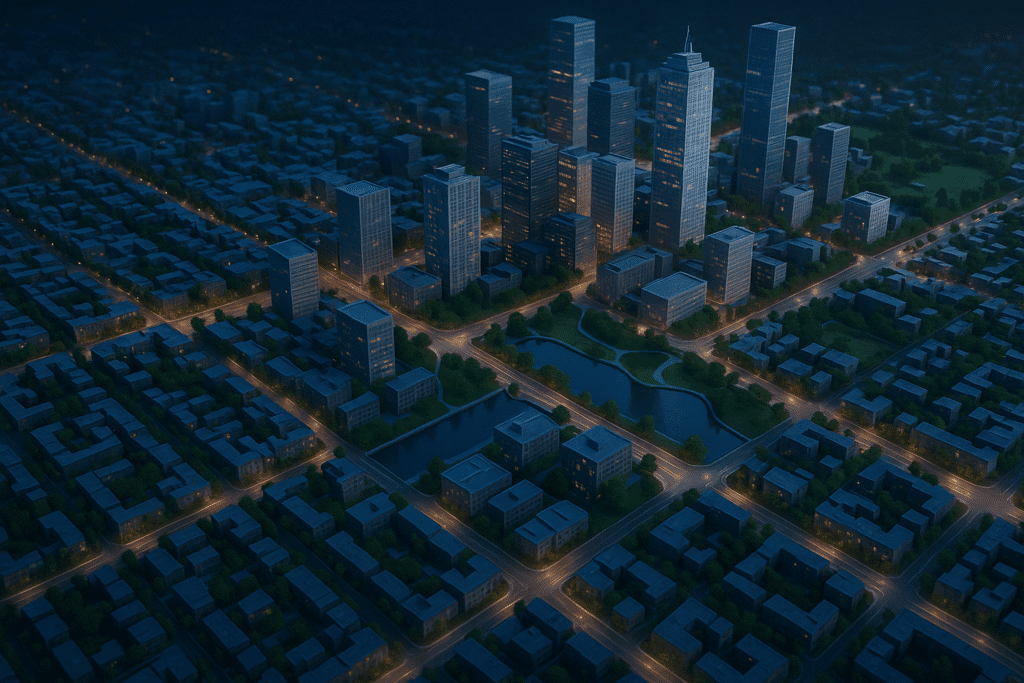
Urban Planning and Development
We support the implementation of digital twin models to advance Smart City Development globally. Our models aid in smart zoning, real-time monitoring of urban expansion, identifying unauthorized constructions, and bolstering disaster resilience through effective planning and evacuation zone modeling.
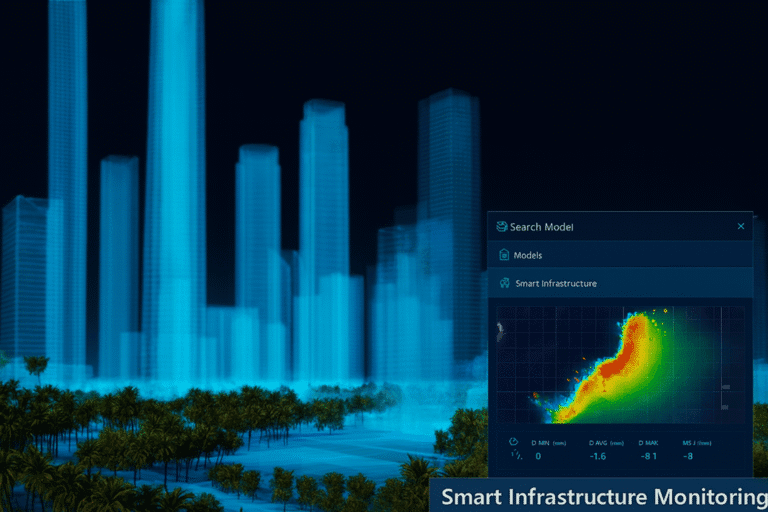
Smart Infrastructure Monitoring
With InSAR technology layered into the digital twin, we detect subsidence or deformation in bridges, roads and buildings with millimeter-level accuracy, enabling predictive maintenance and remote asset inspection.
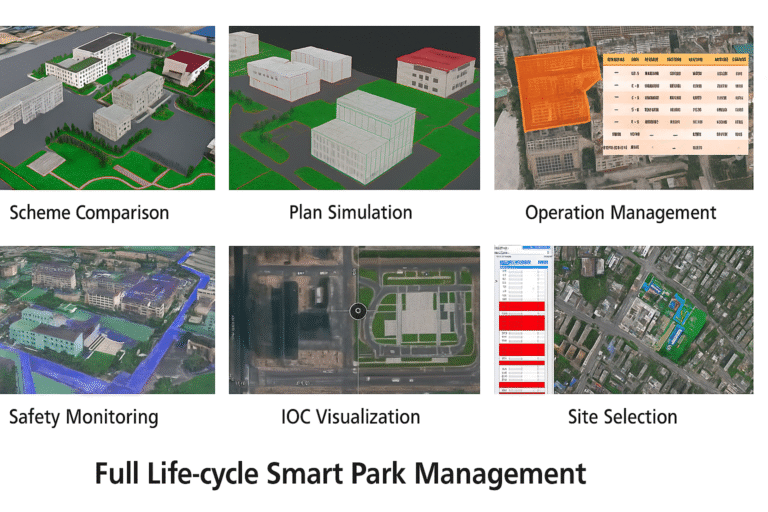
Full Life-cycle Smart Park Management
For smart parks and new districts, the digital twin covers the whole life cycle: investment and site selection (interactive 3D exhibitions, virtual site selection), planning (Planning One-Map and multi-screen scheme comparison), construction (time-linked 3D simulation, progress tracking, remote supervision) and operations, where an Intelligent Operations Center (IOC) runs 24/7 video patrols, IoT perimeter alerts, parking guidance, predictive equipment maintenance and energy and environmental monitoring.
Plug Your City Model Into Any Platform
A city model is only useful if your team can open it. We deliver open, standard formats in the coordinate system you work in, so the same 3D data serves your GIS analysts, engineers, designers and developers.
Web 3D and digital twin viewers
Cesium 3D Tiles and glTF for browser-based viewers and digital twin platforms, built to stream entire cities smoothly.
GIS platforms
I3S scene layers for ArcGIS, plus SHP, GDB and GeoJSON building footprints with height attributes for ArcGIS and QGIS.
CAD and BIM
DWG/DXF, IFC, RVT and DGN, so architects and engineers can place new designs in their real city context.
Game engines and simulation
FBX, OBJ and glTF for Unreal Engine, Unity and Blender: training simulators, drone and driving simulation, and immersive fly-throughs.
AR and mobile apps
Lightweight glTF models load into augmented reality frameworks and mobile 3D viewers for on-site visualisation.
Analytics and point clouds
LAS/LAZ point clouds and GeoTIFF DSMs for your own scripts, models and analysis software.
Why Choose XRTech Group for 3D City Modelling
The difference is in how we source imagery, run production and hand over your data.
Multi-Constellation Capture
Access to many optical satellites means more capture opportunities over your city and a shorter wait for clear, cloud-free stereo.
Source Data on Request
Ask for the original stereo pairs with RPC files alongside the model, so your team can re-process the data or extend the area later.
One Partner, Imagery to Model
Imagery sourcing, processing and modelling stay with one team, with no hand-offs between an imagery vendor and a separate 3D contractor.
No Export Delays
As a non-U.S. provider, our imagery is not subject to U.S. export licensing, which removes a common source of delay on international projects.
Clouds Are Not a Blocker
Where persistent cloud blocks optical sensors, LT-1 radar InSAR adds elevation data, so projects in tropical and coastal cities keep moving.
Matching Terrain and Imagery
The city model can ship with the DEM, DSM and orthophoto it was built from, so buildings, terrain and imagery line up in every viewer.
Trusted Partnership
We are the global distributor for China Siwei Surveying and Mapping Technology Co., Ltd, leveraging decades of experience and robust ground infrastructure.
Start your 3D project
Custom 3D City Models and Digital Twins tailored to your specific needs.
Request a ConsultationHow to Order a 3D City Model
From first message to finished city model in four steps.
01
Send your area
Share a KML, shapefile or simply the city name, plus any deadline you are working to.
02
Choose LOD and format
Pick LOD1, LOD2 or a textured model, plus your output format and coordinate system.
03
Get your quote
Receive a quote listing the proposed imagery, LOD, accuracy and delivery timeline.
04
Receive your model
Files arrive by secure cloud transfer, checked against the source imagery and ready to load.
3D City Model FAQ
Answers to the questions planners, engineers and GIS teams ask most about city modelling. Reviewed by Mustafa Jawaad, General Manager, XRTech Group.
How is a 3D city model different from Google Earth 3D?
Google Earth 3D is built for viewing, and its data cannot be exported for GIS, CAD or engineering work. A commissioned 3D city model is licensed data delivered to you: georeferenced, measurable, attributed per building and ready to load into your own software.
What is the difference between a DSM and a 3D city model?
A DSM is a raster grid of surface heights, where buildings and trees are simply higher pixels. A 3D city model turns that surface into separate building objects with footprints, heights and attributes, so each building can be selected, measured, styled or analysed on its own.
Should I choose stereo or tri-stereo imagery for a city model?
Stereo uses two viewing angles and suits most cities. Tri-stereo adds a near-vertical third view that fills hidden areas behind tall buildings and in narrow streets, which makes it the better choice for dense downtowns and high-rise districts.
Do I need ground control points for a 3D city model?
Not for most planning, visualisation and telecom work. Ground control points are worth adding for engineering design, cadastral updates or any project that must align with survey data, because they tighten both vertical and horizontal accuracy.
How recent is the imagery behind the model?
Archive imagery dates vary by city, and every quote lists the capture date of the stereo pairs we propose. If the model must show current conditions or a specific date, we book new satellite tasking instead.
What is the smallest area you can model?
Satellite stereo projects usually start from about 25 km², roughly a large district or a small town. For a single building or a small campus, drone capture is usually more economical.
Can you add our existing BIM, CAD or LiDAR data to the model?
Yes. Point clouds (.xyz, .las), BIM (.ifc, .rvt), 3D models (.fbx, .3ds) and vector data (.shp, .kml) can be merged into the city model, so new designs and detailed surveys sit in their real surroundings.
How much does a 3D city model cost?
Cost depends on area, level of detail and whether archive imagery is available. Stereo imagery costs about 2x the mono rate and tri-stereo about 3x, and modelling is quoted by km² and LOD. See our satellite imagery pricing, or send us your area for a quote.
Get a Quote for Your 3D City Model
Tell us which city you need, what the model must help you decide and which platform your team uses. A geospatial specialist will reply with the right approach.