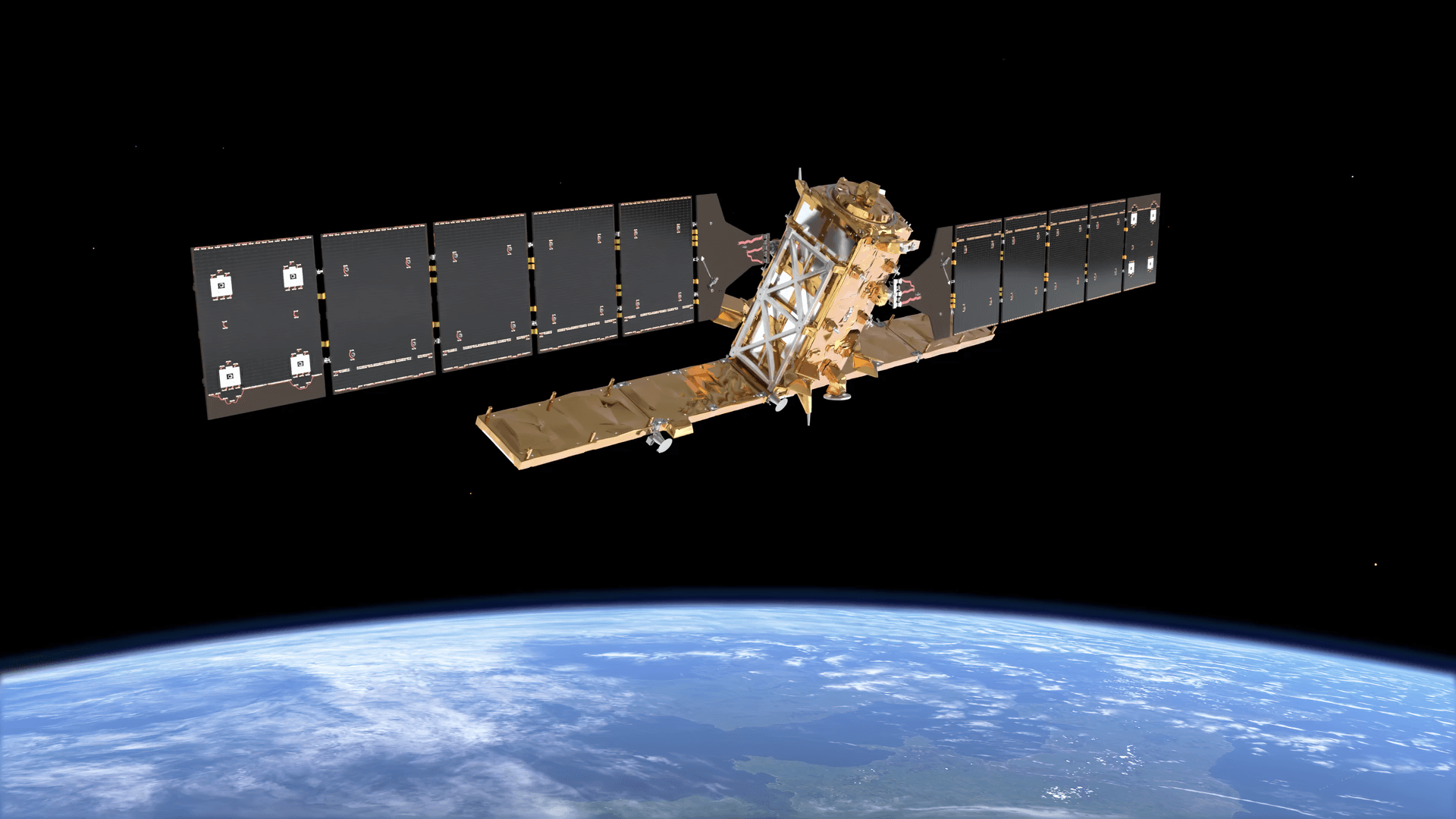
Quick answer: Do satellites ever collide? Yes, but rarely. Only one collision between two whole satellites has ever been recorded: on 10 February 2009 the working Iridium 33 and the dead Russian satellite Cosmos 2251 hit each other at about 11.7 km/s, roughly 790 km above Siberia, and both were destroyed. A handful of other satellites have been hit by pieces of debris. Satellites don't crash into each other more often because space is huge, every object larger than about 10 cm is tracked from the ground, and operators fire thrusters to move out of the way when the chance of a hit passes a set limit. Starlink satellites alone made more than 355,000 of these avoidance maneuvers between June 2025 and May 2026.
About 40,000 objects are now tracked in Earth orbit, and about 11,000 of them were working satellites when the European Space Agency published its 2025 Space Environment Report. The rest are dead satellites, spent rocket stages and fragments. Below is every confirmed accidental collision, the closest recent near misses, how often collisions happen, and the system that keeps satellites from crashing into each other.
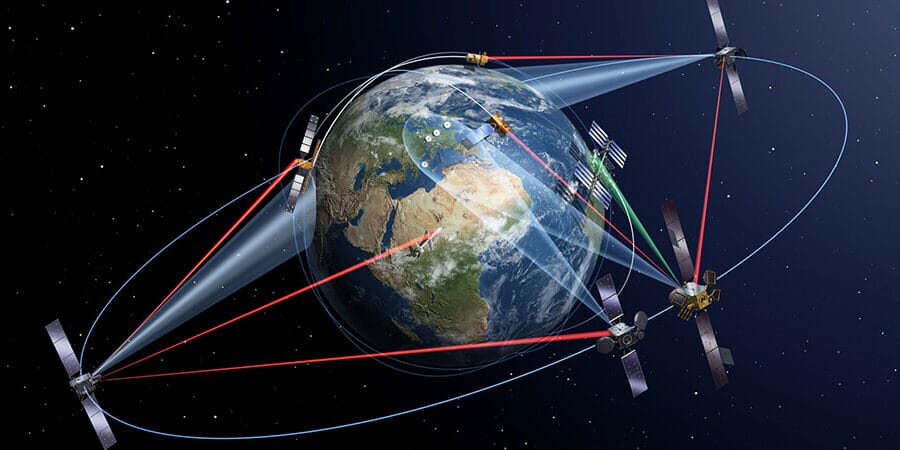
Satellites share space with dead spacecraft, rocket stages and debris. Most traffic sits in low Earth orbit, below 2,000 km.
Have Satellites Ever Collided?
Yes. The 2009 Iridium and Cosmos crash is the famous one, but it was not the first collision in orbit. Space surveillance analysts have confirmed a small number of accidental collisions between catalogued objects, most of them a satellite being hit by a fragment of an old rocket or another satellite. When the Chinese weather satellite Yunhai-1 02 broke apart in 2021, analysts described it as only the fifth confirmed accidental collision between two catalogued objects.
Date
Objects involved
What happened
Result
December 1991
Kosmos 1934 and a debris fragment
A dead Soviet navigation satellite was struck by a piece of debris from another Soviet satellite, Kosmos 926
The earliest confirmed accidental collision, identified later from tracking data
24 July 1996
Cerise (France) and an Ariane rocket fragment
A fragment from an Ariane rocket stage that had exploded in 1986 hit the satellite at about 14 km/s
4.2 m of its stabilisation boom was torn off. Engineers regained control with new software
10 February 2009
Iridium 33 (US) and Cosmos 2251 (Russia)
A working communications satellite and a dead military satellite collided at about 11.7 km/s, 790 km above Siberia
Both satellites destroyed and more than 2,000 trackable fragments created
22 January 2013
BLITS (Russia) and a suspected debris fragment
Russian scientists reported a sudden change in the satellite's orbit and spin, consistent with a strike by debris from the 2007 Fengyun-1C test
Satellite lost. The cause was reported as a likely debris hit
22 May 2013
NEE-01 Pegaso (Ecuador) and debris from a Tsyklon-3 rocket stage
Ecuador's first satellite passed through a cloud of debris from an old Soviet rocket stage and is believed to have been grazed
Left tumbling and unable to operate normally
18 March 2021
Yunhai-1 02 (China) and a Zenit-2 rocket fragment
A small fragment from the 1996 launch of Russia's Cosmos 2333 hit the satellite, according to the US Space Force
The satellite broke up, and 37 fragments were catalogued
Only the 2009 event involved two intact satellites. Every other confirmed case was a satellite hit by debris, which is the bigger risk today: there are far more fragments in orbit than working satellites.
How Often Do Satellites Collide?
Collisions between large, tracked objects are rare. Six confirmed or strongly suspected cases in about 30 years works out to roughly one every five years, and only one of those was satellite against satellite. Impacts from small debris are a different story. Particles too small to track hit spacecraft all the time, and most cause no more than pits and scratches.
NASA's Orbital Debris Program Office puts the average impact speed between debris and a spacecraft at about 10 km/s, and up to about 15 km/s. At those speeds even a small object carries a lot of energy, so the number of objects matters more than their size. ESA's estimate of what is in orbit, based on its MASTER debris model, looks like this:
Object size
Estimated number in orbit
What a hit can do
Larger than 10 cm
About 54,000 (about 40,000 of them tracked)
Destroy a satellite and create a new debris cloud
1 cm to 10 cm
About 1.2 million
Disable or break up a satellite. Mostly too small to track routinely
1 mm to 1 cm
About 140 million
Damage solar panels, windows, cables and sensors
Real examples of small impacts include Sentinel-1A, an ESA radar satellite whose solar panel was hit in August 2016 by a particle a few millimetres across, leaving a damaged area about 40 cm wide. In May 2021 the Canadian Space Agency found a small hole punched through the thermal blanket of Canadarm2 on the International Space Station. In November 2025 a suspected debris strike cracked a window on China's Shenzhou-20 capsule, and its crew came home nine days late in a different spacecraft.
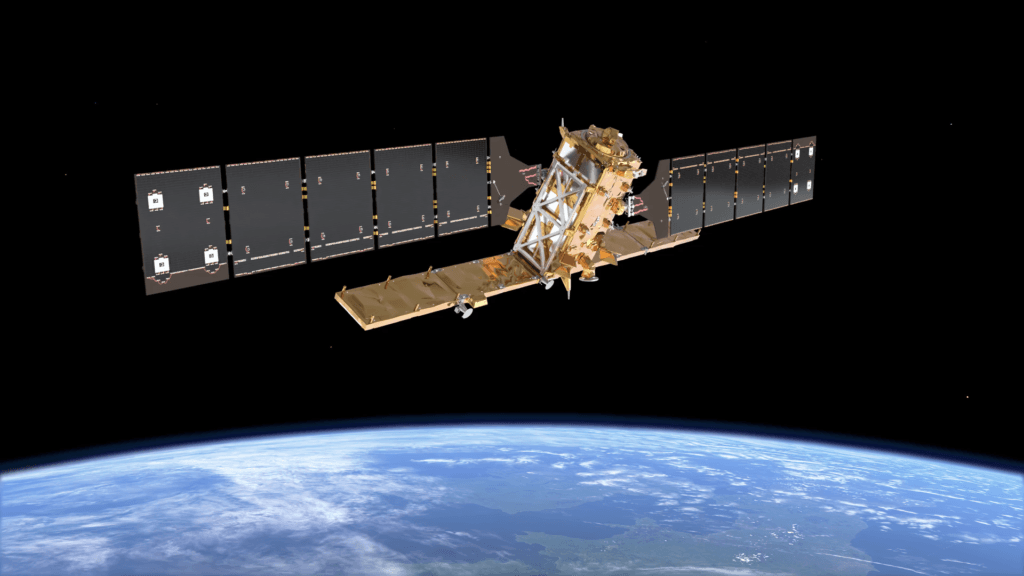
A Sentinel-1 radar satellite. In 2016 a particle a few millimetres wide hit Sentinel-1A's solar array, and the satellite kept working.
Recent Near Misses
Close calls happen far more often than collisions, and some have been very close.
Date
Objects
Closest distance
Notes
28 February 2024
NASA's TIMED and the dead Russian satellite Cosmos 2221
Less than 10 m
Neither craft could maneuver. Both were at about 600 km
December 2025
A Starlink satellite and a payload from a Chinese Kinetica-1 launch
About 200 m, according to SpaceX
SpaceX said there had been no coordination. The launch company said the pass came about 48 hours after separation
Most years
International Space Station and tracked debris
Maneuver when risk exceeds 1 in 10,000
NASA says the station dodges debris about once a year on average
Why Don't Satellites Crash Into Each Other?
Satellites don't crash into each other because several layers of protection work together. These are the main ones:
- Space is very large. The region from 200 km to 2,000 km above Earth holds about 1.27 trillion cubic kilometres. Even with tens of thousands of objects, most pass each other at distances of many kilometres.
- Orbits are spread out. Satellites fly at different altitudes and inclinations, and big constellations are arranged in separate shells. In geostationary orbit, slots along the equator are coordinated through the International Telecommunication Union, and in the US the FCC spaces satellites about two degrees apart.
- Everything large is tracked. The US Space Force keeps a catalogue of tracked objects and shares it through Space-Track.org. ESA and commercial radar networks such as LeoLabs add their own measurements.
- Every close approach is screened. Computers compare predicted orbits days ahead and send operators a warning, called a conjunction data message, when two objects are expected to pass close together.
- Operators move their satellites. If the probability of a collision passes a set threshold, the satellite fires its thrusters to change its path slightly. The usual threshold is 1 in 10,000. SpaceX says Starlink satellites move at about 3 in 10 million.
- Dead satellites are removed. In the US, the FCC requires satellites in low Earth orbit to deorbit within five years of the end of their mission. Geostationary satellites are pushed about 300 km higher into a graveyard orbit when they retire.
The weak point is that a satellite can only dodge if it is working and has propellant. Dead satellites and debris can't move, so when two of them are on a collision course, no one can stop it. That is what happened with TIMED and Cosmos 2221, which missed by luck, not by planning.
Protection layer
How it works
Who runs it
Orbit planning
Separate altitudes, shells and inclinations for each system
Satellite operators, coordinated with regulators
Slot coordination
Assigned positions along the geostationary belt
International Telecommunication Union and national regulators
Tracking
Radar and optical sensors measure the positions of objects larger than about 10 cm
US Space Force, ESA, commercial networks
Conjunction screening
Orbit predictions compared days ahead to flag close approaches
US Space Force, operators, commercial services
Avoidance maneuvers
Small thruster burns change the orbit when risk is too high
Satellite operators
Disposal rules
Deorbit low satellites, raise retired geostationary satellites
FCC, IADC guidelines, space agencies
How Satellite Collision Avoidance Works, Step by Step
- Track: ground radars and telescopes measure where each object is and update its orbit.
- Predict: software projects every orbit several days into the future and looks for pairs that will come close.
- Warn: the operator receives a conjunction data message with the time, the expected miss distance and the uncertainty.
- Assess: the operator calculates the probability of a collision, usually refining it as newer tracking data arrives.
- Decide and burn: if the probability stays above the threshold, the satellite makes a small thruster burn, often hours to a day before the closest approach.
- Check: the new orbit is screened again to make sure the maneuver hasn't created a new close approach with something else.
Starlink automates most of this. Its satellites receive warnings and plan their own avoidance maneuvers. Most other operators still review each warning and decide by hand, which is why the number of satellites in orbit is putting pressure on how this process works.
Starlink and Satellite Collisions
Starlink is now the largest satellite constellation, with more than 10,000 satellites in orbit. SpaceX reports its avoidance maneuvers to the US Federal Communications Commission every six months, and the numbers have climbed quickly:
Reporting period
Avoidance maneuvers
Change
June to November 2025
148,696
Previous six months
December 2025 to May 2026
207,152
Up by about 58,000
12 months to May 2026
More than 355,000
Roughly 40 per satellite per year
There are two ways to read these numbers. SpaceX says its very cautious threshold, about 300 times stricter than the common 1 in 10,000, means it moves far more often than it strictly needs to, which lowers real risk. Debris researchers point out that every maneuver relies on good tracking data and working spacecraft, and that so many close approaches show how crowded the busiest altitudes have become. Both points hold. SpaceX has also begun lowering more than 4,000 Starlink satellites from about 550 km to about 480 km, where atmospheric drag brings any dead satellite down faster.
What Happens When Satellites Collide?
A collision at orbital speed is closer to an explosion than a car crash. A 1 cm aluminium ball weighs about 1.4 g, but at 10 km/s it carries about 70 kilojoules of energy, about the same as a one-tonne car driving into a wall at 42 km/h. When two satellites weighing hundreds of kilograms collide, both shatter into thousands of pieces.
- A debris cloud forms. Fragments spread along the original orbits and, over months, around the whole planet at that altitude.
- The debris lasts. Below about 500 km, drag brings fragments down within a few years. At 800 km they can stay up for decades or longer. Hundreds of Iridium 33 and Cosmos 2251 fragments were still in orbit 15 years after the crash.
- Other satellites must dodge. Every new tracked fragment adds conjunction warnings for operators at that altitude.
- The pieces burn up on the way down. Small fragments that re-enter the atmosphere burn up long before they reach the ground.
What Is Kessler Syndrome?
Kessler syndrome is the idea that once enough objects are packed into one orbital region, collisions create debris faster than drag removes it, and each collision raises the chance of the next. NASA scientists Donald Kessler and Burton Cour-Palais described it in 1978. It would not happen in a single dramatic moment. It would build up over years and decades, and make some altitudes too risky to use.
Researchers disagree about how close we are. A 2025 study by Sarah Thiele and colleagues introduced the CRASH Clock, a measure of how long it would take for a catastrophic collision to happen if every operator stopped maneuvering at once. Using June 2025 data, they estimated 2.8 days, compared with 121 days in 2018. That figure does not predict a collision. It shows how much orbital safety now depends on constant tracking and maneuvering.
Satellite Collisions vs Deliberate Destruction
Some of the worst debris events were not accidents. Anti-satellite missile tests have destroyed satellites on purpose, and those debris clouds raise the collision risk for everyone else.
Event
Country
Altitude
Debris
Fengyun-1C test, January 2007
China
About 865 km
More than 3,000 trackable fragments, many still in orbit
USA-193, February 2008
United States
About 250 km
Low altitude, so most debris re-entered within months
Microsat-R, March 2019
India
About 280 km
Most debris re-entered within a year
Cosmos 1408, November 2021
Russia
About 480 km
More than 1,500 trackable fragments. The ISS crew took shelter in their spacecraft
The Fengyun-1C test and the 2009 Iridium and Cosmos collision together more than doubled the catalogued debris below 1,000 km within two years.
Are Satellite Collisions Becoming More Likely?
Yes, the risk is rising, although the safety system is improving too. ESA reports that around 550 km altitude there is now a similar number of dangerous debris objects as active satellites. It also counts intact satellites and rocket bodies re-entering the atmosphere more than three times a day on average. Several new breakups in 2024 added thousands of fragments, including the break-up of the Intelsat 33e satellite in geostationary orbit in October 2024.
On the other side, tracking is getting more precise, more operators share their orbit data, rules such as the FCC's five-year deorbit requirement are cutting how long dead satellites stay in orbit, and constellations are being placed lower, where failed satellites come down faster. Whether collisions stay rare depends on how well those measures keep up with the number of launches.
What Satellite Collisions Mean for Earth Observation
Earth observation satellites mostly fly in sun-synchronous orbits between about 500 and 800 km, which includes some of the most crowded altitudes. They travel at about 7.5 km/s, as explained in our guide to how fast satellites move, so their operators run the same screening and avoidance process as every other operator. A maneuver can occasionally shift an imaging pass, and a collision could take a satellite out of service.
This is one reason buyers benefit from using several constellations rather than one. XRTech Group sources imagery from more than 130 optical, radar and hyperspectral satellites, so if one satellite is unavailable another can usually cover the same area. SAR satellites add coverage through cloud and darkness, and stereo satellite imagery supports elevation models and 3D mapping.
Need Satellite Imagery You Can Rely On?
Tell us your area of interest, the resolution you need and how recent the images must be. We will check archive and new-capture options across more than 130 satellites and send you a free quote.
Frequently Asked Questions
Has a satellite ever crashed into another satellite?
Yes, once. On 10 February 2009 the working US communications satellite Iridium 33 and the dead Russian satellite Cosmos 2251 collided about 790 km above Siberia. It is still the only known collision between two intact satellites. Other collisions have involved satellites hit by debris.
How many satellites are in orbit?
ESA counted about 11,000 active satellites among roughly 40,000 tracked objects in its 2025 Space Environment Report. The number has grown since, and Starlink alone has passed 10,000 satellites.
Can satellites dodge each other?
Working satellites with propellant can. Operators get warnings days ahead and fire small thrusters to change the orbit if the collision risk is too high. Dead satellites and debris can't move at all.
What would happen if two satellites collided?
Both would most likely be destroyed and break into hundreds or thousands of fragments. The fragments would spread around Earth at that altitude and stay there for years to centuries, depending on how high the collision happened.
Could a satellite collision knock out GPS or the internet?
A single collision would not take down a whole system. GPS and large internet constellations have spare satellites, and a lost satellite can be replaced. The bigger concern is a growing debris field that makes an orbit harder and more expensive to use.
Has the International Space Station been hit by debris?
Yes, by small particles. Its windows have chips, and in 2021 a small hole was found in the Canadarm2 robotic arm's thermal blanket. The station is heavily shielded and moves out of the way of tracked debris about once a year on average.
Does debris from satellite collisions fall to Earth?
Eventually, for objects in low orbits. Drag slowly lowers fragments until they re-enter and burn up. Below about 500 km this takes a few years. At 800 km or higher it can take decades or longer.
Who tracks satellites and space debris?
The US Space Force runs the largest public catalogue and shares it through Space-Track.org. ESA, other national agencies and commercial companies such as LeoLabs also track objects and send collision warnings to operators.
What is the closest two satellites have come without colliding?
One of the closest publicly confirmed misses was on 28 February 2024, when NASA's TIMED spacecraft and the dead Russian satellite Cosmos 2221 passed within less than 10 m of each other at about 600 km. Neither could maneuver.
Do satellites collide in geostationary orbit?
No collision between two satellites in geostationary orbit has been confirmed. Satellites there move in the same direction at almost the same speed and are kept in assigned slots. Breakups have still happened there, such as Intelsat 33e in October 2024.
Sources
- NASA Orbital Debris Program Office: Frequently Asked Questions
- ESA: Space Environment Report 2025
- ESA: Copernicus Sentinel-1A satellite hit by space particle
- NASA: TIMED mission close approach with Cosmos 2221
- Surrey Satellite Technology: Cerise mission history
- US Space Force 18th Space Defense Squadron, reported by SpaceNews: Yunhai-1 02 breakup
- SpaceX: Starlink semi-annual constellation reports to the FCC
- Thiele et al.: An Orbital House of Cards, the CRASH Clock (arXiv preprint)
- Federal Communications Commission: Space Innovation, Mitigation of Orbital Debris in the New Space Age (five-year rule)
- Inter-Agency Space Debris Coordination Committee: Space Debris Mitigation Guidelines
- Kessler and Cour-Palais: Collision Frequency of Artificial Satellites, the Creation of a Debris Belt (Journal of Geophysical Research)
- Canadian Space Agency: Canadarm2 debris strike update

Mustafa Jawaad
General Manager, XRTech Group
Mustafa helps governments and critical industries get satellite and UAV data in days rather than weeks, from archive search and new satellite tasking to processed maps, so teams can plan infrastructure faster and with less risk. Connect on LinkedIn.