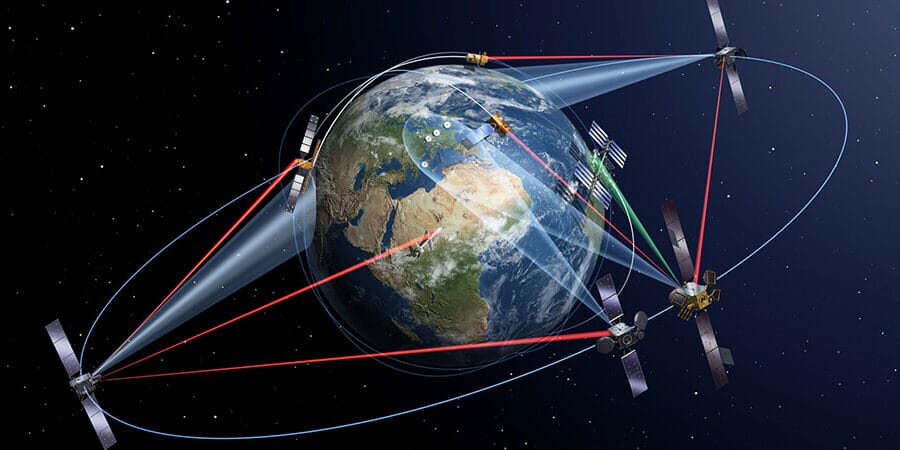
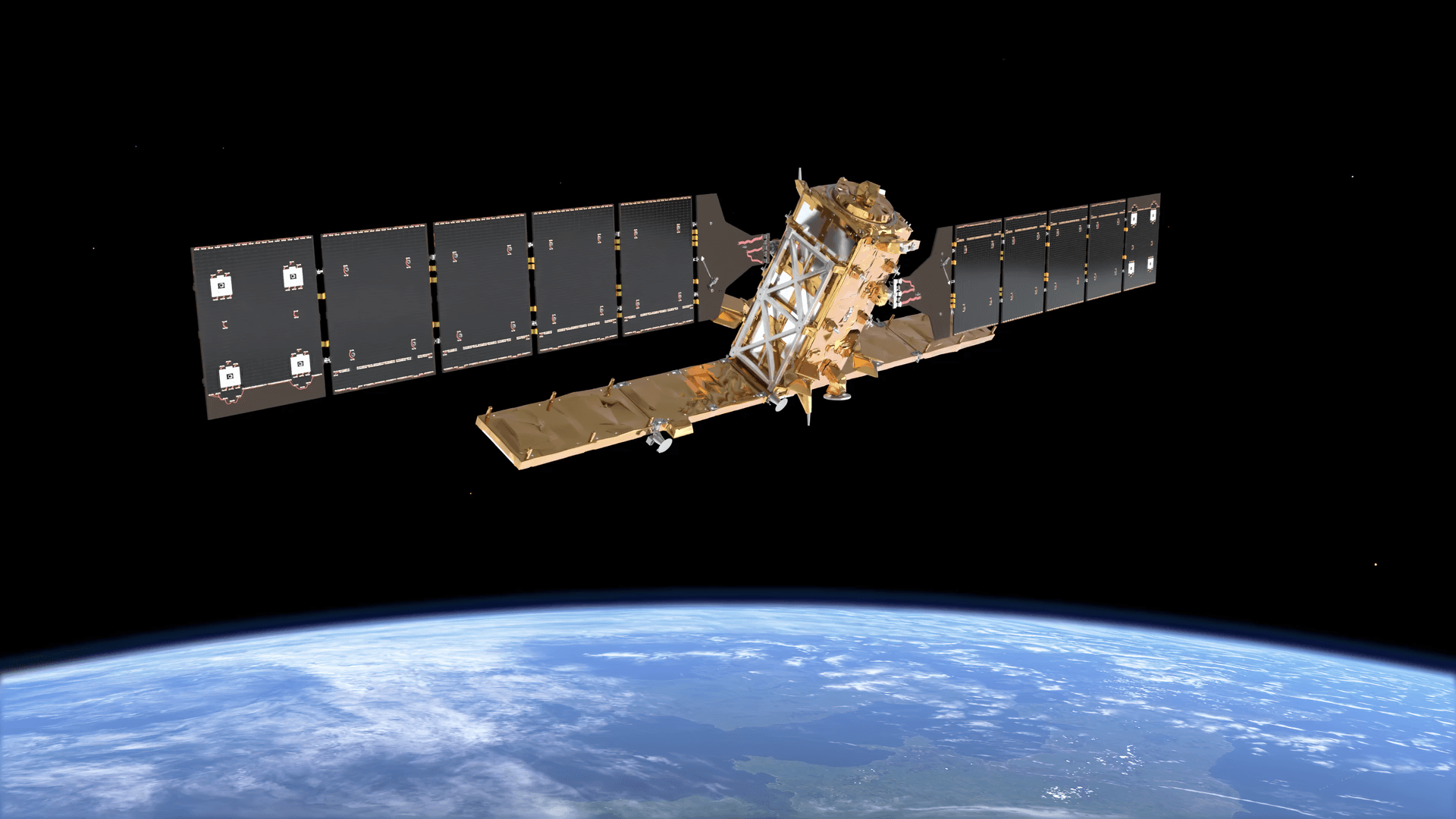
Quick answer: What do satellites look like in the night sky? A satellite looks like a star that moves. It is a steady point of white or pale yellow light that glides across the sky in a straight line at a constant speed, with no blinking lights and no sound. Most take a few minutes to cross the sky, and many fade out partway across as they pass into Earth's shadow. Typical satellites are about as bright as the fainter stars you can see, while the International Space Station can rival Venus. Satellites have no lights of their own. You see sunlight reflecting off them, so the best time to look is from about 45 minutes to two hours after sunset or before sunrise.
There are a lot of them to look for. Astronomer Jonathan McDowell's satellite catalogue listed about 16,800 active satellites in September 2026, about 11,100 of them Starlink, plus thousands of dead satellites and spent rocket stages. Only a small share are bright enough to see without a telescope at any moment, but on a clear evening away from city lights you can usually spot several within a few minutes. This guide covers what satellites look like from Earth, how to tell them apart from stars, planes and meteors, when to look, and the free apps that tell you exactly what you saw.
What Do Satellites Look Like From Earth?
Up close, a satellite is a box or cylinder with solar panels, often about the size of a car or a van. From the ground it is hundreds of kilometres away, far too small to show any shape, so all you see is a single point of light. These are the signs that the point of light is a satellite:
- It moves steadily. A satellite travels in a straight line at an even pace. It never stops, turns or hovers.
- It shines without blinking. There are no red, green or white flashing lights like those on an aircraft.
- It is silent. Satellites orbit hundreds of kilometres up, well above the atmosphere.
- It changes brightness gently. Most brighten as they rise higher and fade as they sink lower or move away.
- It can vanish in mid-sky. When a satellite enters Earth's shadow, it dims over a few seconds and disappears, even though it is still in orbit.
- Some flash at regular intervals. Dead satellites and old rocket stages often tumble, so they catch the Sun every few seconds and pulse on and off.
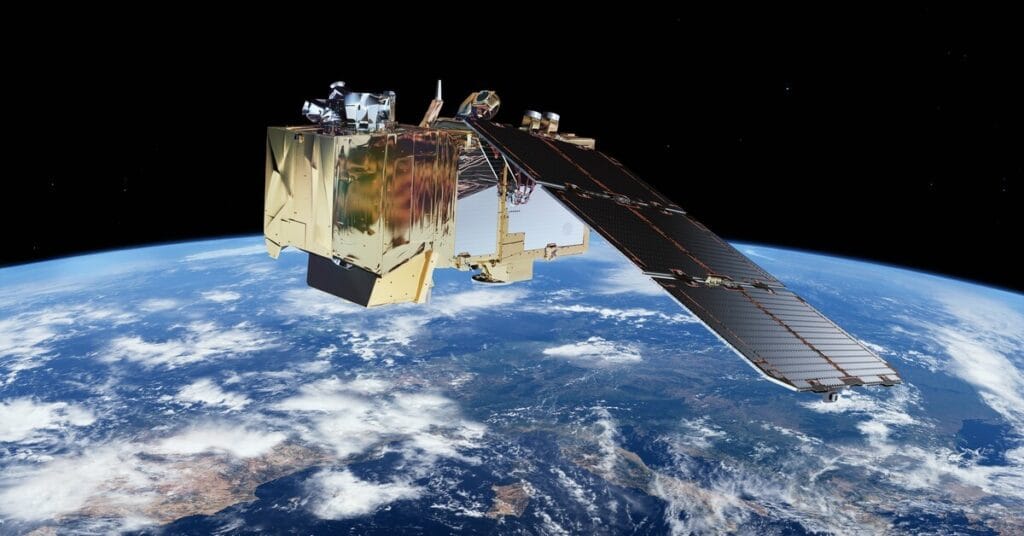
Up close, an Earth observation satellite such as Sentinel-2 is a spacecraft a few metres long with a solar panel. From the ground it looks like a moving point of light.
Do Satellites Look Like Stars?
Yes. At a glance a satellite looks just like a star, and that is why most people only notice one when the "star" starts to move. The movement is the giveaway. Stars stay fixed in their patterns and only drift very slowly across the sky as Earth turns. A low Earth orbit satellite crosses from one side of the sky to the other in minutes. Directly overhead, the International Space Station moves about 1 degree per second, which is about two full Moon widths every second.
Brightness also helps. Most satellites you can see with the naked eye fall between magnitude +3 and +6 on the astronomical brightness scale, about the same as the fainter stars in a dark sky. Smaller numbers mean brighter objects: Sirius, the brightest star, is about magnitude -1.5, and Venus can reach about -4.5.
How to Tell a Satellite From a Plane, Star, Meteor or Planet
Object
How it moves
What its light looks like
How long you see it
Satellite
Straight line at a steady speed
Steady white or pale yellow point, no flashing lights. May fade out mid-sky
About 1 to 6 minutes
International Space Station
Straight line, faster than most satellites
Very bright, steady, often slightly golden
Up to about 7 minutes
Starlink train
A line of satellites following each other
A string of evenly spaced lights
Several minutes, mostly in the first days after a launch
Aircraft
Steady, but can turn or change height
Flashing red, green and white lights. Often audible
Many minutes
Meteor (shooting star)
Very fast streak
Brief flash, sometimes with a trail
Under a second to a few seconds
Star
Fixed, turns slowly with the whole sky
Twinkles, especially near the horizon
All night
Planet
Fixed among the stars over a night
Bright and steady, twinkles less than stars
Hours
If a light is moving and has no flashing lights, it is almost certainly a satellite. If it blinks red and green, it is a plane. If it streaks across in a second, it is a meteor.
Can Satellites Be Seen at Night?
Yes, but only while they are still in sunlight. Satellites don't glow. After sunset the ground is dark, but a satellite hundreds of kilometres up can still be lit by the Sun, and against the dark sky it shines like a star. As the night goes on, Earth's shadow reaches higher and swallows the satellites one by one.
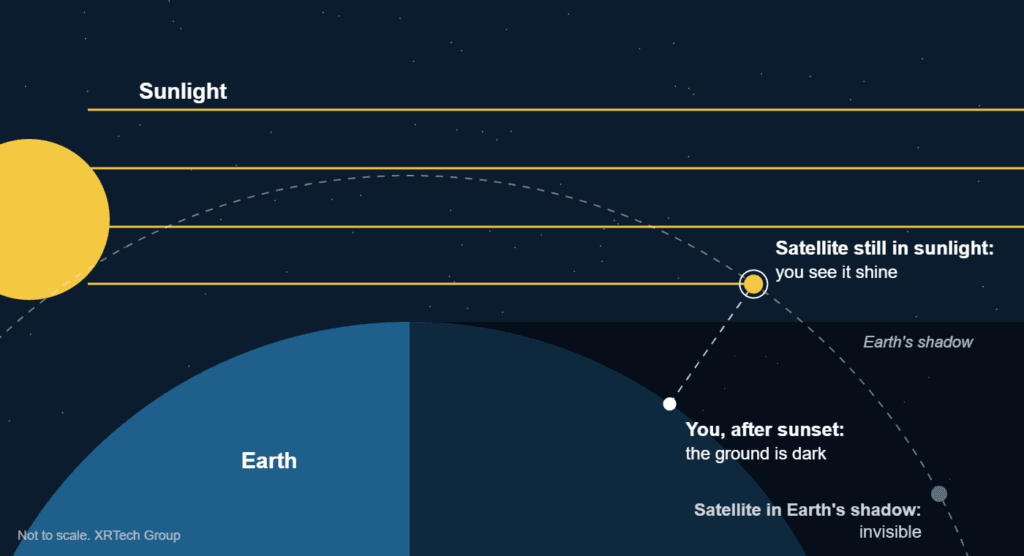
After sunset you are in Earth's shadow, but a satellite high above can still catch sunlight. Once it passes into the shadow, it disappears.
How long after sunset you can see a satellite depends on its altitude. For a satellite directly overhead, it stays sunlit until the Sun is a certain angle below the horizon. These angles are calculated from simple orbital geometry and ignore small effects from the atmosphere:
Altitude
Example
Sunlit overhead until the Sun is about
420 km
International Space Station
20 degrees below the horizon
480 km
Lower Starlink shells
22 degrees below the horizon
550 km
Higher Starlink shells
23 degrees below the horizon
786 km
Sentinel-2 Earth observation satellites
27 degrees below the horizon
1,200 km
OneWeb satellites
33 degrees below the horizon
20,200 km
GPS satellites
76 degrees below the horizon, but too faint to see without a telescope
Astronomical twilight ends when the Sun is 18 degrees below the horizon. In winter the Sun drops far below that, so low satellites disappear after the first few hours of darkness and come back before dawn. Around the summer solstice at mid and high latitudes, the Sun may never sink more than about 15 to 25 degrees below the horizon, so some satellites stay visible all night.
What Does a Satellite Look Like at Night? Examples to Look For
Object
Typical peak brightness
Can you see it with the naked eye?
International Space Station
About magnitude -4 on good passes
Yes, even from a city
Tiangong (China's space station)
About magnitude -2
Yes, about as bright as Jupiter
AST SpaceMobile BlueBird satellites
About +3.4 on average, up to about +0.5 overhead
Yes, often easily
Starlink trains after launch
Bright while satellites are low and close together
Yes, for a few days after a launch
Starlink satellites in their final orbits
About +6 to +7 for most newer satellites
Rarely. Most are at or below the naked-eye limit
Typical bright satellites and rocket stages
About +3 to +6
Yes, from a dark site
Geostationary satellites
Much fainter
No, you need a telescope
The International Space Station
The ISS is the brightest satellite in the sky. It looks like a fast, very bright star, often with a slightly golden tint, and on a good pass it can be the brightest object in the sky after the Moon and Venus. It orbits at about 420 km, crosses most of the sky in four to six minutes, and is easy to see from light-polluted cities. NASA's Spot the Station service lists passes for your location.
Tiangong
China's space station orbits a little lower than the ISS and is smaller, so it is fainter, but at about magnitude -2 on a favourable pass it still outshines every star.
Starlink Satellites and Starlink Trains
For the first days after a launch, Starlink satellites travel close together in a line, so they look like a string of pearls moving across the sky. As they raise their orbits they spread out and get fainter. SpaceX added sunshades, dark coatings and mirror films after astronomers raised concerns, and studies of the newer Starlink satellites measured an average brightness of about magnitude 7.1, below what most people can see. Individual satellites still flare briefly at some angles.
BlueBird Satellites
AST SpaceMobile's BlueBird satellites carry very large antennas, which makes them some of the brightest satellites after the space stations. Observers measured an average brightness of about magnitude 3.4, rising to about 0.5 when a satellite is nearly overhead.
Flashing Satellites and Rocket Stages
A light that pulses on and off every few seconds is usually a tumbling object, often a spent rocket stage or a dead satellite. Each flash is sunlight glinting off a flat surface as it rotates.
Iridium Flares, Now Gone
For about 20 years the first-generation Iridium satellites produced famous flares, bright flashes of up to about magnitude -8 that lasted a few seconds as sunlight hit their flat antennas. The replacement Iridium NEXT satellites have a different shape, and the old ones were retired by the end of 2019, so Iridium flares no longer happen.
How to Spot a Satellite at Night
- Pick a clear night. Thin cloud or haze hides fainter satellites.
- Go out at the right time. Start about 45 minutes after sunset and look for the next hour or two, or go out in the two hours before sunrise.
- Get away from bright lights. The ISS is visible from a city, but a dark site shows many more satellites.
- Let your eyes adjust. Give them 15 to 20 minutes without looking at a bright phone screen. Use a red light or night mode if you need to check your phone.
- Look about halfway up the sky. Lie back or sit in a reclining chair so you can take in a wide area without craning your neck.
- Watch for a star that moves. Relax your gaze and let movement catch your eye. Side vision is good at noticing motion.
- Look toward where the Sun set as the night goes on. Earth's shadow rises from the opposite side of the sky first, so later in the evening the satellites that are still lit tend to be on the sunset side.
On a clear, dark night a patient observer can typically see somewhere between 5 and 20 satellites an hour in the evening twilight, with far fewer around midnight in winter.
How to Identify a Satellite in the Night Sky
Once you have spotted a moving light, these clues help you work out what it is:
Clue
What it tells you
Direction of travel
The ISS, Tiangong and Starlink usually move from west to east. Polar and sun-synchronous satellites move roughly north to south or south to north
Speed
Faster usually means lower. The ISS crosses the sky in a few minutes, and higher satellites take longer
Brightness
Brighter than every star suggests the ISS or Tiangong. Faint and steady suggests an ordinary satellite
Fading out mid-sky
The object entered Earth's shadow, which confirms it was a satellite and not a plane
Regular flashing
A tumbling rocket stage or dead satellite
Several lights in a line
A Starlink train, usually seen soon after a launch
To identify the exact satellite, note the time, the direction it moved and roughly where it appeared and disappeared, then check a tracking app. Most apps show every pass for your location, so you can match what you saw to a name.
How to Track Satellites at Night: Free Apps and Websites
Tool
Platforms
Best for
Heavens-Above
Website and Android app
Pass predictions for the ISS, Tiangong, Starlink and thousands of other objects, with sky charts and brightness estimates
NASA Spot the Station
iOS and Android
ISS passes only, with alerts and an augmented reality view that points you to the station
ISS Detector
iOS and Android
Simple pass alerts for the ISS, Tiangong and Starlink, with add-ons for other satellites
N2YO
Website
Live satellite positions on a map and pass lists for any object
See A Satellite Tonight
Website
Pass predictions shown on a sky view or a Google Street View of your own location
Find Starlink
Website
Visibility times for Starlink trains after recent launches
Stellarium
Desktop and mobile
A full planetarium that can also plot satellites against the stars
For the best results, allow location access so predictions match your exact position, and check the predicted brightness: passes brighter than about magnitude +3 are easy to see, while passes near +5 need a dark sky. To learn how these apps know where every satellite is, and how accurate they are, read how to track live satellites in space.
Can You See Satellites With Binoculars or a Telescope?
Binoculars show many more satellites, because they reveal objects too faint for the naked eye. Keep them steady and let satellites drift through the field of view rather than chasing them. Telescopes have a narrow view and satellites move quickly, so following one is hard without a motorised tracking mount. With good tracking, experienced observers have photographed the solar panels of the ISS. Geostationary satellites, which sit about 35,786 km above the equator, are too faint for the naked eye but can show up in telescope images as fixed points while the stars trail past.
Are Satellites Changing the Night Sky?
They are, and astronomers are watching closely. Satellites leave streaks across long-exposure telescope images, and the growing number of large constellations raises the chance that a given image is affected. The International Astronomical Union recommends that satellites be fainter than about magnitude 7 so that they stay invisible to the naked eye. Some operators have made real changes: newer Starlink satellites are, on average, around that level. Others, including the very large BlueBird satellites, are much brighter. For casual stargazers, the effect is mostly that more moving lights appear in the hours after dusk and before dawn.
Why Most Earth Observation Satellites Pass in Daylight
Many imaging satellites fly in sun-synchronous orbits, which cross the equator at the same local time on every pass. Sentinel-2, for example, crosses at about 10:30 in the morning, so its passes happen in full daylight when you can't see it. Its orbit is designed that way so every image has similar lighting. Satellites in dawn-dusk orbits are the exception, and they can be seen in twilight. They move at around 7.5 km/s, as explained in our guide to how fast satellites move, and they share crowded orbits with thousands of other spacecraft, which is why operators track every close approach, as covered in our article on whether satellites ever collide.
XRTech Group sources imagery from more than 130 optical, radar and hyperspectral satellites, from archive scenes to new captures of your site. SAR satellites can image at night and through cloud, so you are not limited by daylight or weather.
See Your Site From Space
Tell us your area of interest, the resolution you need and how recent the images must be. We will check archive and new-capture options across more than 130 satellites and send you a free quote.
Frequently Asked Questions
What does a satellite look like to the naked eye?
A satellite looks like a star moving steadily across the sky in a straight line. It has no flashing lights, makes no sound and usually crosses the sky in a few minutes, sometimes fading out before it reaches the horizon.
Do satellites blink?
Most don't. A working satellite shines with a steady light. A satellite or rocket stage that is tumbling can flash every few seconds as its surfaces catch the Sun. A light with regular red and green flashes is an aircraft.
Why do satellites disappear in the middle of the sky?
They move into Earth's shadow. Satellites only shine while sunlight reaches them, so when a satellite passes into the shadow it fades within a few seconds, even though it keeps moving.
Can you see satellites in the middle of the night?
Fewer, because most low satellites are in Earth's shadow. In summer at mid and high latitudes the Sun stays close enough below the horizon that some satellites remain lit all night, and higher satellites stay sunlit longer.
How fast does a satellite move across the sky?
A low Earth orbit satellite usually crosses from horizon to horizon in about 4 to 10 minutes. Directly overhead, the ISS moves about 1 degree per second, roughly two Moon widths every second.
What is the line of lights moving across the sky?
It is almost always a Starlink train: a group of Starlink satellites launched together, still travelling close to each other before they spread out into their final orbits.
Can you see satellites from a city?
You can see the brightest ones. The ISS and Tiangong are easy to spot from a city, and some bright satellites are visible too. A dark site away from streetlights shows many more.
What is the brightest satellite in the sky?
The International Space Station. On a good pass it reaches about magnitude -4, brighter than any star and close to Venus.
Can you see geostationary satellites from Earth?
Not with the naked eye. Geostationary satellites orbit about 35,786 km above the equator, more than 80 times higher than the ISS, so they are too faint without a telescope.
How do I know if a light in the sky is a satellite or a UFO?
Check whether it moves steadily in a straight line without flashing lights. If it does, enter the time and direction into a tracking app such as Heavens-Above or N2YO. Most moving lights turn out to be satellites, Starlink trains, aircraft or planets.
Sources
- Jonathan McDowell: General Catalog of Artificial Space Objects, active satellite statistics
- NASA: Spot the Station
- Heavens-Above: satellite pass predictions
- arXiv study: brightness of Starlink Generation 2 Mini satellites
- arXiv study: initial observations of the first BlueBird spacecraft and a model of their brightness
- Sky and Telescope: the newest and largest Starlink satellites are also the faintest
- International Astronomical Union Centre for the Protection of the Dark and Quiet Sky from Satellite Constellation Interference
- ESA: Sentinel-2 mission overview
- Space.com: how to see China's Tiangong space station

Mustafa Jawaad
General Manager, XRTech Group
Mustafa helps governments and critical industries get satellite and UAV data in days rather than weeks, from archive search and new satellite tasking to processed maps, so teams can plan infrastructure faster and with less risk. Connect on LinkedIn.