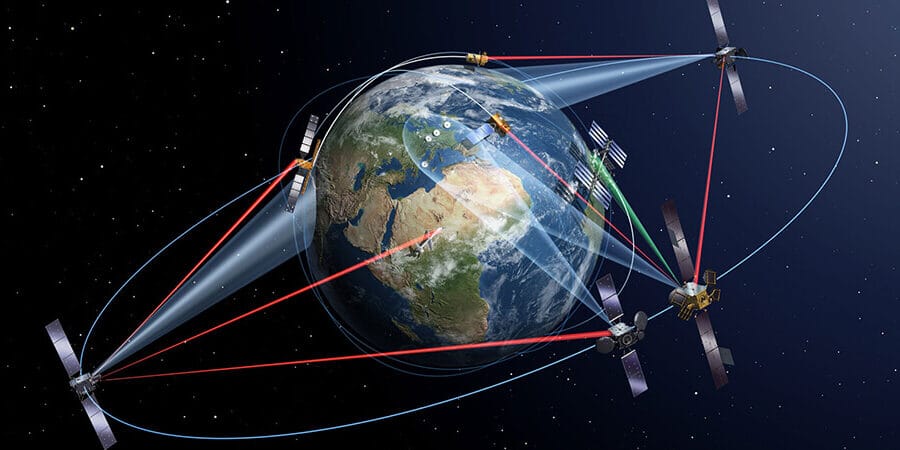
Quick answer: How are satellites powered? Almost every satellite orbiting Earth is solar powered. Solar panels (solar arrays) turn sunlight into electricity, and rechargeable lithium-ion batteries store part of it so the satellite keeps working while it passes through Earth's shadow, its version of night. A power control unit regulates the voltage and feeds the instruments, radios, computers and heaters. Spacecraft that travel far from the Sun, such as Voyager, use radioisotope thermoelectric generators (RTGs), which turn heat from decaying plutonium-238 into electricity.
Above the atmosphere, sunlight delivers about 1,361 watts per square metre, roughly a third more than the strongest midday sun at the ground, with no clouds or weather to block it. That makes solar the default power source for satellites in Earth orbit. The sections below cover how satellites get power, how they run at night, how much power real satellites use, what powers spacecraft far from the Sun, and whether satellites run out of power.
How Do Satellites Get Power?
Satellites get power from an electrical power system (EPS) that does three jobs: it generates electricity with solar arrays, stores it in a battery, and regulates and distributes it through a power control unit. Engineers size every part for the end of the mission, not launch day, because solar cells and batteries slowly lose capacity in orbit.
Component
What it does
Typical hardware
Solar arrays
Convert sunlight into direct current (DC) electricity
Multi-junction gallium arsenide cells on deployable wings or body panels
Solar array drive
Rotates the wings to keep them facing the Sun as the satellite orbits
Motorised rotary joint (solar array drive mechanism)
Battery
Powers the satellite in Earth's shadow and covers short peaks in demand
Lithium-ion cells; nickel-hydrogen on older satellites
Power control unit
Regulates bus voltage, manages battery charging, protects against faults
Regulators, shunts and charge controllers
Distribution
Switches and protects the power line to each subsystem
Power distribution unit with fuses or current limiters
Loads
Use the power
Cameras or radar, transmitters, onboard computer, reaction wheels, heaters, electric thrusters
Power flows along a DC bus. Small satellites commonly use a 28 volt bus, while high-power communications satellites use higher voltages, often 50 or 100 volts, to cut current and cable mass. The International Space Station distributes primary power at about 160 volts and converts it to about 124 volts for its equipment.
Are Satellites Solar Powered?
Yes. Solar power is the standard for satellites in low, medium and geostationary Earth orbit, from small CubeSats to the International Space Station. The first solar-powered satellite, Vanguard 1, launched on 17 March 1958 and transmitted until 1964. Sputnik 1, launched a few months earlier on batteries alone, fell silent after 21 days when its three silver-zinc batteries ran flat. Vanguard 1 is still in orbit, the oldest human-made object in space.
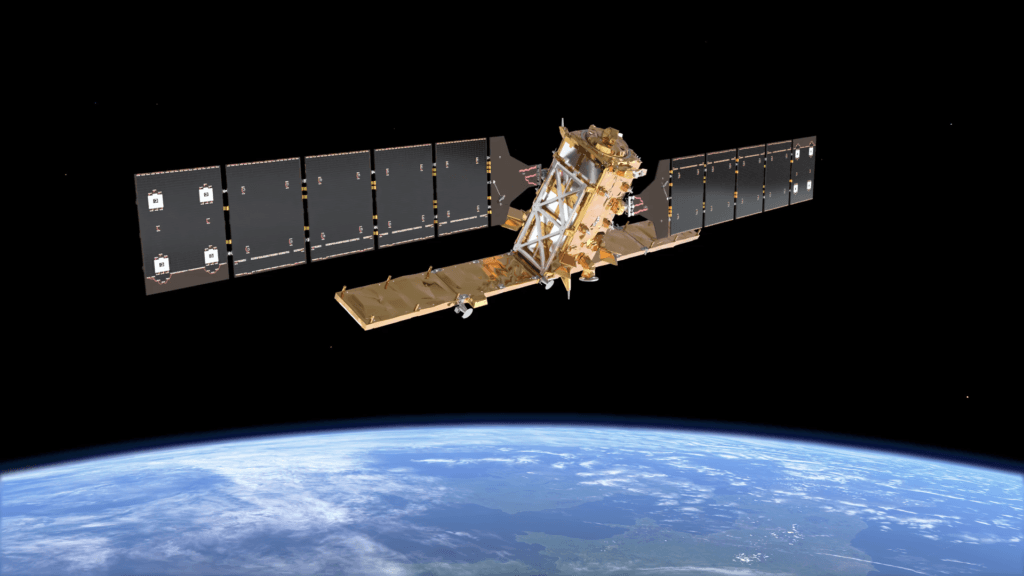
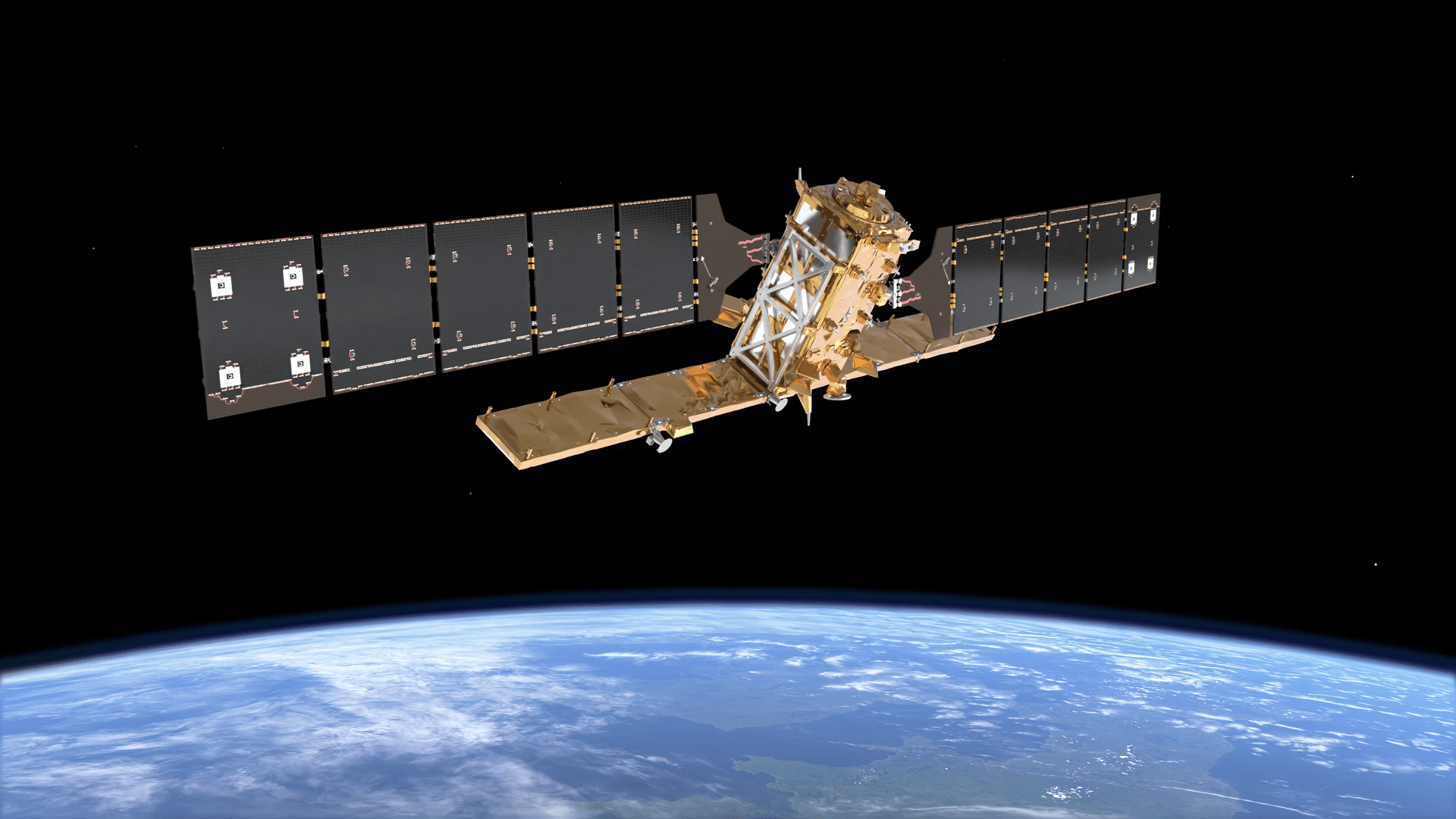
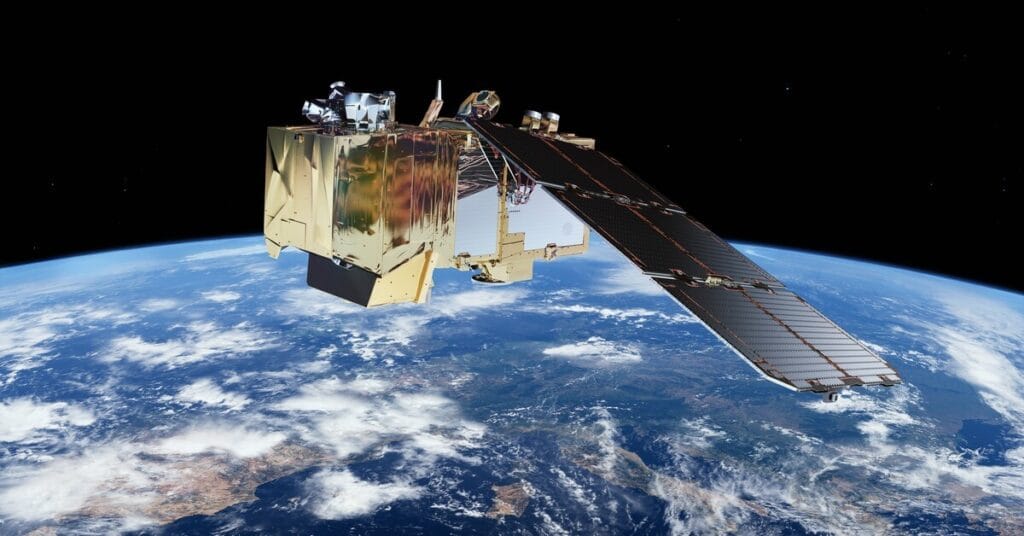
Sentinel-1, a radar imaging satellite, with its solar array wing deployed.
How Satellite Solar Panels Work
A solar cell is a layered semiconductor. Sunlight knocks electrons loose inside it, and the cell's built-in electric field pushes them out as current. Thousands of cells are wired in series to raise the voltage and in parallel to raise the current. Satellite cells are multi-junction cells: two, three or more semiconductor layers stacked on top of each other, each tuned to a different part of the solar spectrum, so they convert far more of the light than a single silicon layer. A thin cover glass on each cell shields it from radiation and tiny particle impacts.
Arrays are either body-mounted, with cells fixed to the outside of the spacecraft (common on CubeSats), or deployable wings that unfold after launch. Newer roll-out designs, such as the ISS Roll-Out Solar Arrays (iROSA), launch rolled up like a carpet and unroll in orbit. Each of the six iROSA wings added to the station produces about 20 kW, using cells around 30% efficient, compared with about 14% for the station's original silicon arrays.
Types of Satellite Solar Cells
Cell type
Typical efficiency
Where it is used
Trade-off
Silicon
About 14 to 17%
Original ISS arrays, older and low-cost satellites
Cheap, but heavier per watt and less radiation tolerant
Single-junction gallium arsenide
About 19 to 22%
Satellites from the 1990s onward, some small satellites
More efficient and radiation tolerant than silicon
Triple-junction (GaInP/GaAs/Ge)
About 28 to 30%
Most current commercial and government satellites, iROSA
Industry standard; in geostationary orbit, cells keep about 88% of their output after 15 years
Advanced multi-junction (four or more junctions)
About 30 to 33%
High-power and mass-sensitive missions
Highest output per kilogram, highest cost
How Much Power Does a Satellite Need?
A satellite needs anywhere from a few watts to hundreds of kilowatts, depending on its size, payload and orbit. Radar imaging, high-throughput communications and electric propulsion use the most power. Published figures for real spacecraft:
Spacecraft
Type
Power
Power source
CubeSat (1U to 3U)
Small research or technology satellite
A few watts to a few tens of watts
Body-mounted or small deployable panels, lithium-ion battery
Sentinel-2
Optical Earth observation, about 786 km
About 1,700 W
7.2 m² solar array, 87 Ah battery
ViaSat-3
Geostationary broadband satellite
Arrays generate well over 30 kW
Eight solar panels, among the largest commercial arrays built
International Space Station
Crewed station, about 400 km
About 215 kW generating capacity
Eight original array wings plus six iROSA, 24 lithium-ion batteries
Juno
Jupiter orbiter
About 14 kW near Earth, about 500 W at Jupiter
Three solar wings with 18,698 cells
Voyager 1
Interstellar probe
About 470 W at launch, now less than half
Three RTGs
To size the system, engineers build a power budget: the energy every load needs over one orbit plus a safety margin, compared with what the arrays deliver in sunlight after losses and ageing. The arrays must run the satellite and recharge the battery during the sunlit part of each orbit, so they are sized well above the satellite's average consumption.
How Do Satellites Get Power at Night?
At night, satellites run on batteries. A satellite's night is the time it spends in Earth's shadow, called an eclipse. The solar arrays produce nothing in the shadow, so the battery powers the satellite until it returns to sunlight. The arrays then take over the loads and recharge the battery, and the cycle repeats on every orbit that crosses the shadow.
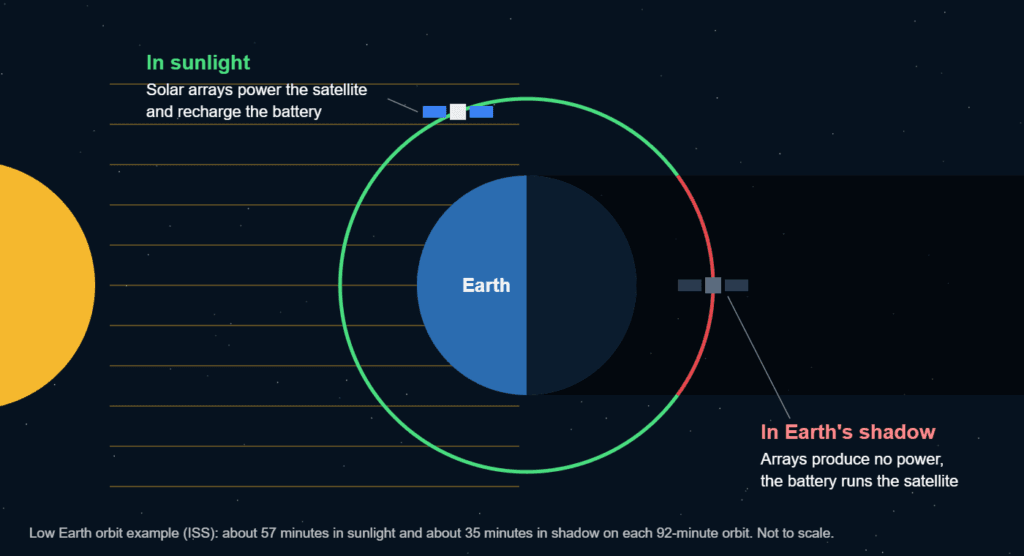
Night on the ground does not mean night for the satellite. A satellite a few hundred kilometres up stays in sunlight for a while after sunset at the surface, which is why you can see satellites in the evening sky. Our guide on what satellites look like in the night sky explains this in detail. How long a satellite spends in shadow depends on its orbit:
Orbit
Orbital period
Longest time in shadow
How often it is eclipsed
Low Earth orbit (ISS, about 400 km)
About 92 minutes
About 35 minutes
About 15 to 16 times a day for most of the year
Dawn-dusk sun-synchronous orbit (Sentinel-1, about 693 km)
About 99 minutes
Short eclipses in part of the year only
Rides the line between day and night, so it stays sunlit almost all the time
Medium Earth orbit (GPS, about 20,200 km)
About 12 hours
About 55 minutes
Two eclipse seasons a year, each several weeks long
Geostationary orbit (35,786 km)
23 hours 56 minutes
About 72 minutes, at the equinoxes
Once a day during two seasons of roughly six weeks around the March and September equinoxes
Satellite Batteries: How They Last for Years
A low Earth orbit satellite goes through about 5,500 charge and discharge cycles a year, so its battery is run at a shallow depth of discharge, using only part of its capacity in each eclipse, which greatly extends its life. A geostationary satellite sees only about 90 eclipses a year and can discharge its battery more deeply each time. Charge control and heaters keep the cells within a narrow temperature range, because cold and overcharging both shorten battery life.
Well-managed batteries outlast their design life. Hubble's original nickel-hydrogen batteries were designed for five years and lasted 19 before astronauts replaced them in 2009. On the ISS, 48 nickel-hydrogen batteries were replaced by 24 lithium-ion units, half as many, in a program that took 14 spacewalks and finished in early 2021.
Battery type
Used on
Strengths and limits
Silver-zinc
Sputnik 1 and other early, short missions
High energy, but short life and few charge cycles
Nickel-cadmium
Most satellites from the 1960s to the 1980s
Reliable, but heavy for the energy stored
Nickel-hydrogen
Geostationary satellites, Hubble, the original ISS batteries
Very long cycle life, but bulky pressure-vessel cells
Lithium-ion
Standard on new satellites and the ISS today
Most energy per kilogram and long cycle life, but needs tight charge and temperature control
What Powers Satellites in Space Far From the Sun?
Far from the Sun, spacecraft use either very large solar arrays or nuclear power. Sunlight weakens with the square of the distance from the Sun, so at Jupiter, about 5.2 times farther out than Earth, a panel receives under 4% of the sunlight it would get in Earth orbit.
Location
Distance from the Sun
Sunlight available to a solar panel
Earth orbit
1 AU
100%, about 1,361 W/m²
Mars
About 1.52 AU
About 43%, about 590 W/m²
Jupiter
About 5.2 AU
About 3.7%, about 50 W/m²
Saturn
About 9.5 AU
About 1.1%, about 15 W/m²
NASA's Juno showed that solar power can work at Jupiter, but only with three wings carrying 18,698 cells: they produced about 14 kW near Earth and produce about 500 W at Jupiter. Beyond Jupiter, solar arrays become impractically large.
Radioisotope Thermoelectric Generators (RTGs)
An RTG makes electricity from heat with no moving parts. Plutonium-238 decays naturally and gets hot; thermocouples between the hot fuel and the cold of space turn the temperature difference into electricity. Plutonium-238 has a half-life of about 87.7 years, so output falls slowly and predictably, and the spare heat keeps the spacecraft warm. NASA's Perseverance rover runs on one Multi-Mission RTG that produced about 110 W at the start of its mission and charges two lithium-ion batteries for peaks of up to 900 W.
Each Voyager carries three RTGs that together produced about 470 W at launch in 1977. Output drops by about 4 W a year and is now less than half the original, so NASA switches off heaters and instruments in a pre-agreed order. On 17 April 2026, engineers turned off Voyager 1's Low-energy Charged Particles instrument, which had run almost continuously for nearly 49 years, to keep the spacecraft operating.
Nuclear Reactors and Fuel Cells
Only a few satellites have flown real fission reactors. The United States launched one, SNAP-10A, in 1965; it ran for 43 days before a non-nuclear electrical fault shut it down. The Soviet Union powered more than 30 RORSAT radar ocean surveillance satellites with BES-5 reactors producing about 3 kW of electricity, and the 1978 crash of one of them, Kosmos 954, scattered radioactive debris over northern Canada. Hydrogen-oxygen fuel cells powered the crewed Gemini, Apollo and Space Shuttle missions, which lasted days or weeks, but they consume stored reactants, so they are not used on long-life satellites.
Satellite Power Sources Compared
Power source
How it works
Best for
Examples
Solar arrays and batteries
Photovoltaic cells convert sunlight; batteries cover time in shadow
Earth orbit and the inner solar system
Nearly all Earth satellites, the ISS, Juno
RTG
Heat from plutonium-238 decay converted by thermocouples
Outer planets, long darkness, dusty surfaces
Voyager 1 and 2, Cassini, Curiosity, Perseverance
Fission reactor
Controlled uranium fission heats a power converter
High power for long periods (so far mostly experimental)
SNAP-10A, Soviet RORSATs
Fuel cells
Hydrogen and oxygen combine to make electricity and water
Short crewed missions
Gemini, Apollo, Space Shuttle
Primary (non-rechargeable) batteries
Stored chemical energy used until the cells are empty
Missions lasting hours to weeks
Sputnik 1, the Huygens probe that landed on Titan
Do Satellites Run Out of Power?
Not suddenly. Solar cells and batteries lose capacity gradually over years, and engineers size them for end-of-life conditions so the satellite still has enough power when its mission is due to end. RTG-powered probes are the clearest case of running out of power, and even Voyager's decline has taken almost five decades.
What wears out
What happens
How operators handle it
Solar cells
Radiation and repeated heating and cooling slowly cut output
Arrays are oversized at launch to leave end-of-life margin
Batteries
Capacity fades with charge cycles and age
Shallow discharge, temperature control, bypassing failed cells, cutting loads during eclipses
RTGs
Output drops a few watts a year as the fuel decays and thermocouples age
Planned shutdown of heaters and instruments, as on Voyager
Power electronics and wiring
A failed regulator, cable or array drive can cut power
Redundant circuits and fault protection that switches to backups
Power is rarely what ends a satellite's life. Missions more often end because the satellite runs out of propellant for orbit control, a key component fails, or a newer satellite replaces it. At the end of a mission, operators passivate the satellite: they discharge or disconnect the batteries and vent leftover propellant so the dead satellite cannot explode later and create debris. Explosions and collisions are the main sources of space debris; see do satellites ever collide for how operators avoid them.
Why Satellite Power Matters for Earth Observation
For imaging satellites, power is a daily operating limit. Every minute of imaging, onboard data storage and downlink to ground stations draws on the same power budget as the battery recharge, so a satellite can collect only a limited number of images on each orbit. Radar satellites such as Sentinel-1 are especially power hungry because they transmit their own microwave pulses instead of relying on reflected sunlight.
Those limits shape when and how new imagery can be captured. XRTech Group works with more than 130 satellites, so we can combine archive images with new tasking across several constellations to meet your deadline and resolution. To see how quickly these satellites cover the ground, read how fast satellites move.
Get Recent Satellite Imagery of Your Site
Tell us your area of interest, the resolution you need and how recent the images must be. We will check archive and new-capture options across more than 130 satellites and send you a free quote.
Frequently Asked Questions
Are all satellites solar powered?
Nearly all satellites in Earth orbit are solar powered. The exceptions are a few short missions that run on batteries alone and the Soviet RORSAT radar satellites, which used nuclear reactors. Spacecraft sent far from the Sun often use RTGs instead.
How much power does a satellite solar panel produce?
In Earth orbit, modern triple-junction cells about 30% efficient produce roughly 400 W per square metre of cell area at the start of a mission. A complete array produces less per square metre because of gaps between cells, wiring losses and ageing. Sentinel-2, for example, gets about 1,700 W from a 7.2 m² array.
Why do satellites use gallium arsenide solar cells instead of silicon?
Gallium arsenide multi-junction cells convert about twice as much sunlight as typical silicon cells and degrade less under radiation. They cost more, but every kilogram launched is expensive, so more watts per kilogram and longer life outweigh the higher cell price.
What happens if a satellite's battery fails?
Batteries are built from many cells, so a single failed cell can usually be bypassed. If the whole battery fails, the satellite can only work in sunlight and shuts down in every eclipse. The amateur radio satellite AMSAT-OSCAR 7 went silent in 1981 when its battery shorted, then came back in 2002 when the short opened; it still operates, but only while in sunlight.
Do solar panels work better in space than on Earth?
They receive more light: about 1,361 W/m² above the atmosphere compared with around 1,000 W/m² at the ground on a clear day, with no night-long gaps, clouds or dust in most orbits. The downsides are radiation damage and heat, since cells become less efficient as they warm up.
How do satellites stay warm in Earth's shadow?
Multi-layer insulation blankets slow heat loss, and battery-powered electric heaters switch on to keep batteries, propellant lines and instruments within their safe temperature range. Heater power is part of the eclipse power budget. Deep-space probes may also carry small radioisotope heater units.
Can satellites be recharged or refuelled in space?
A solar-powered satellite recharges its own battery on every sunlit pass, so electricity is not the issue. Propellant is: most satellites cannot be refuelled. Servicing spacecraft such as Northrop Grumman's Mission Extension Vehicle have docked with ageing communications satellites to take over their propulsion and extend their working lives.
Do satellites use nuclear power?
Earth-orbiting satellites today use solar power. Nuclear power is used mainly on deep-space missions and planetary rovers, in the form of RTGs. Fission reactors have flown only on the US SNAP-10A test and Soviet RORSAT satellites.
Does space weather affect satellite power?
Yes. Solar storms raise the number of energetic particles that damage solar cells, which speeds up their loss of output. Electric charge can also build up on spacecraft surfaces during geomagnetic storms and discharge across arrays or electronics, so power systems are designed with shielding and fault protection.
Do Starlink satellites have batteries?
Yes. Like other low Earth orbit satellites, each Starlink satellite carries solar arrays and onboard batteries, because at about 550 km it spends roughly 35 minutes of each 95-minute orbit in Earth's shadow during much of the year.
Sources
- NASA: Electrical system of the International Space Station and ISS Roll-Out Solar Arrays (iROSA)
- NASA: Space station battery replacement program
- NASA: Hubble Space Telescope electrical power system and Servicing Mission 4 batteries
- NASA JPL: NASA Shuts Off Instrument on Voyager 1 to Keep Spacecraft Operating
- NASA JPL: Juno mission facts
- NASA JPL: Mars 2020 Perseverance power system (MMRTG)
- ESA: Inside a solar cell
- ESA: Sentinel-1 and Sentinel-2 mission overviews
- ESA Navipedia: Satellite eclipses
- NOAA Office of Satellite and Product Operations: GOES eclipse schedule
- Viasat and Boeing: ViaSat-3 satellite platform
- AMSAT: History of AMSAT-OSCAR 7
- SAE Technical Paper 650793: SNAP 10A, First Reactor in Space
- Inter-Agency Space Debris Coordination Committee: Space Debris Mitigation Guidelines

Mustafa Jawaad
General Manager, XRTech Group
Mustafa helps governments and critical industries get satellite and UAV data in days rather than weeks, from archive search and new satellite tasking to processed maps, so teams can plan infrastructure faster and with less risk. Connect on LinkedIn.